September 13, 2026
When Faxing a Check Actually Moves Money
Yes, you can fax a check image, but it usually works only for verification or setup purposes, like a voided check for direct deposit. Faxing rarely moves money on its own unless the recipient has a system to convert that image into a depositable check. If your goal is a payment that needs to clear fast, confirm the recipient’s policy before you send anything.
TL;DR:
- Faxing a check is mainly useful for verification or setup purposes, such as providing a voided check for direct deposit, rather than for actual payment processing.
- It is most accepted by employers for setting up payroll or direct deposit, and by vendors for proving payment timing, but rarely for depositing or moving funds directly.
- Properly faxing a check requires clear, full-size images, a detailed cover sheet, and confirmation of successful transmission, preferably with encryption and signed authorization.
- Sharing account details via fax exposes sensitive data to risks, so using encrypted digital alternatives and verifying recipient policies is highly recommended.
- Digital methods like ACH transfers, wire payments, or mailed original checks are more reliable and faster when actual fund transfer clarity is needed.
Faxing a Check: When It Works and When It Fails
Faxing a check succeeds in a narrow set of situations and fails in most others, mainly because a fax transmits a picture, not a negotiable financial instrument. Banks and payroll departments have specific, well-worn reasons for accepting a faxed check image, and it helps to know which category your situation falls into before you spend time preparing documents.
Faxing a check tends to work when:
- Setting up direct deposit or payroll. Employers commonly ask for a faxed voided check to confirm your routing and account numbers, and this is one of the most widely accepted uses of a faxed check image.
- Proving payment timing. If you need to show a vendor or landlord that you sent a payment by a deadline, a fax confirmation with a timestamp can serve as evidence of intent, even though it does not move funds.
- Merchant conversion workflows. Some businesses accept faxed routing and account details, then use check-printing software to generate a Remotely Created Check, but this requires signed authorization and specific software on the receiving end.
Faxing a check fails when you expect it to substitute for a signed original or when you try to deposit a faxed image at your own bank. Tellers cannot process an image without the physical document, and most explainers on faxing checks point out that acceptance depends entirely on the recipient’s own systems, not on the fax itself.
How to Fax a Check Safely, Step by Step
Sending a faxed check the right way takes a little preparation, but the process is straightforward once you know the order of operations. Whether you use an online fax service or a physical fax machine, the goal is the same: produce a legible, complete image and confirm the recipient actually got it.
Start with the document itself. Fill in any memo line, keep your original check, and if the check is smaller than a standard sheet, make a full-size photocopy first so it feeds cleanly through a scanner or fax machine. Attach a cover sheet stating the purpose of the fax (for example, “Voided check for direct deposit”), the amount if relevant, an invoice or account number, and your contact information.
- Scan or photograph the check and convert it to a PDF file.
- Upload the file to an online fax service and enter the recipient’s complete fax number, including area code.
- Enable encryption or secure transmission if the service offers it, especially for financial documents.
- Send the fax and save the confirmation or delivery receipt for your records.
- Call or email the recipient to confirm the fax arrived and that the routing and account numbers are readable.
If you’re using a traditional fax machine instead, photocopy the check onto a full sheet, place it in the feeder, dial the complete number, and collect the confirmation page once transmission finishes. Either way, practical guidance on faxing checks recommends pairing the check image with a signed authorization form, which speeds up data entry on the recipient’s end and reduces the odds of a rejected transmission.
Pro Tip: Attach a completed authorization form alongside your voided check instead of sending the check image alone. It gives the recipient clean, typed data to work from and cuts down on transcription errors when they enter your routing and account numbers.
How Do You Protect Your Account Details When Faxing?
Faxing exposes your routing and account numbers to shared machines, transmission logs, and anyone who happens to be standing near the receiving fax tray. That risk is real enough that analysts covering check payments generally recommend encrypted digital alternatives whenever the recipient allows it.
Run through this checklist before you send:
- Avoid public or shared fax machines; use an encrypted online fax service whenever possible.
- Always include a cover sheet that states the fax’s purpose clearly, and redact any account details that aren’t strictly necessary.
- Verify the recipient’s fax number twice, and confirm their policy on accepting faxed checks before you transmit anything.
- Save your fax confirmation, timestamp, and any signed authorization forms as an audit trail.
- Choose a provider that offers delivery confirmation, since a transmission log alone doesn’t guarantee the recipient actually received a usable copy.
A fax confirmation proves transmission, not deposit. Keeping that paper trail matters far more than most senders realize, particularly if a dispute comes up weeks later and you need to show exactly what you sent and when.
What Happens When a Business Receives a Faxed Check?
Businesses that accept faxed check images don’t just print out the fax and walk it to the bank. They typically enter the routing and account numbers into check-issuing software, which generates a Remotely Created Check, sometimes called an RCC, that the business can then deposit. Because check payments by fax skip the original signature, the recipient’s bank often routes them through manual teller processing since the printed check lacks proper MICR encoding.
That manual step matters for both sides. Required documentation usually includes:
- A signed authorization form from the payer.
- The voided check or faxed check image itself.
- The fax transmission confirmation.
- An internal log entry recording who processed the check and when.
Businesses that skip this documentation expose themselves to disputes if the payer later claims they never authorized the transaction. Printing the recreated check on security paper and keeping every record on file protects both parties, but it also adds administrative overhead. A protective approach to handling customer banking data applies just as much to faxed checks as it does to any other sensitive financial document passing through a retail or office environment. The trade-off is straightforward: faxing feels fast to the sender, but the receiving business absorbs extra steps and potential bank handling delays to convert that image into real money.
Better Alternatives When You Need Funds to Actually Clear
When speed and certainty matter more than convenience, skip the fax and choose a method built to move money, not just an image of it.
- Authorized eChecks or ACH transfers move funds bank to bank with a clear digital audit trail, and they work well for recurring payments or direct-deposit setups.
- Wire transfers or bank bill-pay suit urgent, high-value payments where you can’t afford processing delays.
- Expedited mail or a check-printing and mailing service makes sense when the recipient specifically requires an original signed check.
Choosing between them comes down to what the recipient will actually accept. ACH covers most recurring arrangements, wire transfers handle urgency, and mailed originals cover situations where nothing digital will do. Delays in receivables and remittance processing often trace back to exactly this kind of mismatch between what the sender used and what the recipient’s system could actually process.
What Actually Moves Money vs. What Just Proves Intent
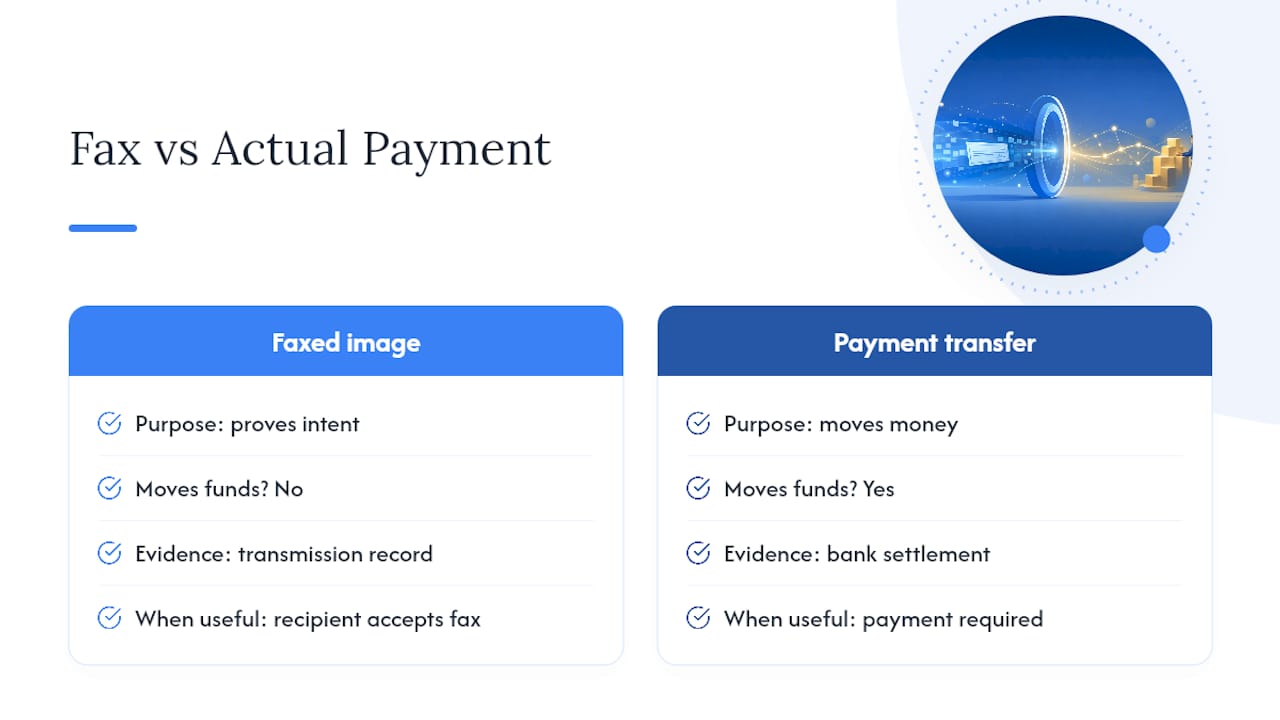
Most confusion around faxing checks comes from treating a transmission record as if it were a bank transaction. It isn’t. A fax confirmation tells you the image arrived somewhere; it says nothing about whether that image turned into deposited funds. That distinction gets lost constantly, especially among small business owners who assume “sent” means “paid.”
The honest recommendation: fax a check only when the recipient explicitly works with faxed images, such as a payroll department requesting a voided check or a vendor verifying payment timing. For anything where money actually needs to move, an eCheck, ACH transfer, or wire beats a fax every time. When faxing is the right tool, a service like PerPageFax removes the friction of finding a machine or paying for a subscription you’ll use once.
— Engin
Send a Voided Check or Authorization Fax Without the Hassle
When a recipient asks for a faxed voided check or authorization form, the service gets it there in minutes without forcing you into a monthly plan you’ll cancel after one use. Pricing is per page, there is no account to create, and transmissions may run through encrypted delivery with automatic retries.
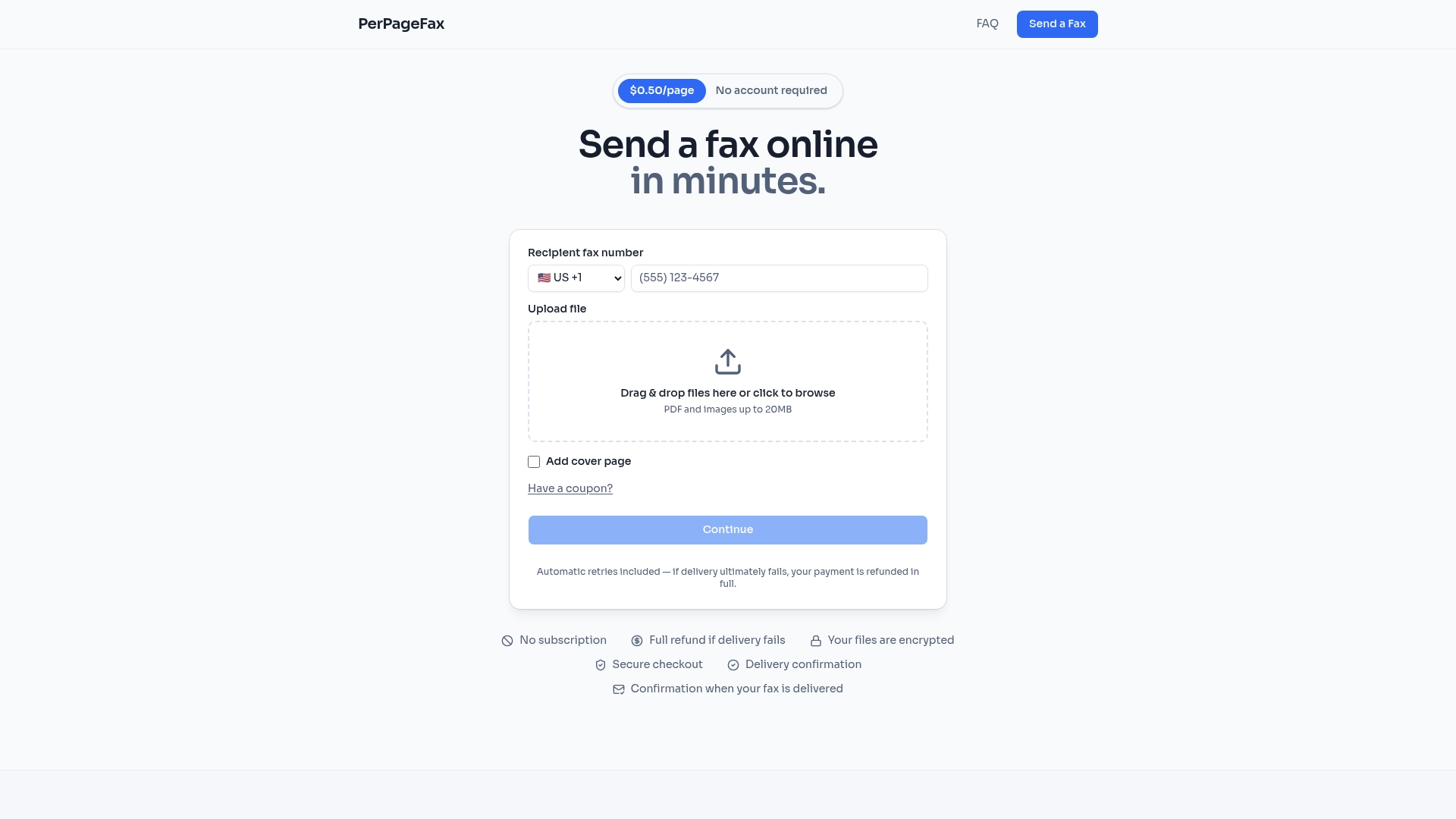
Before you send, use the free cover sheet builder to state your fax’s purpose clearly, exactly the kind of documentation that protects you if a dispute ever comes up. If your check image came from a phone photo or a scanned file, run it through Faxify first to produce a clean, fax-ready PDF instead of a blurry attachment the recipient’s bank might reject. Once your documents are ready, head to Perpagefax and send your fax with delivery confirmation included, so you have proof it arrived, not just proof you tried.
Sources
- Check payments by fax — AccountingTools
- Can You Fax a Check? Yes. Follow These Steps to Do it Safely — TechRepublic
- Can You Fax a Check? The Truth + 5 Better Ways — OnlineCheckWriter
FAQ
Can You Send a Check by Fax?
Yes, but acceptance depends entirely on the recipient. Many businesses accept faxed check images only for voided-check setup or payment verification, not as a way to actually deposit funds.
How Do I Send a Check Electronically Instead of Faxing?
An authorized eCheck or ACH transfer sends the payment directly between banks with a full digital audit trail, which makes it a more reliable option than a faxed image when you need funds to clear.
Can I Get a Single Check From My Bank Without Ordering a Full Book?
Most banks can issue a single counter check or a cashier’s check at a branch visit, which works better than faxing when you need a signed original for a one time payment.
What Is the Safest Way to Send Checks or Check Information?
Using an encrypted online fax service like Perpagefax for voided checks, paired with ACH or wire transfer for actual payments, keeps your account details off shared machines and gives you a confirmed delivery record.
Recommended
Ready to send a fax?
Send your fax online in minutes for $0.50/page — no account needed.
Send a fax now