September 18, 2026
3 Ready-to-Use Fax Confidentiality Statements
The fastest fix is simple: put a short confidentiality notice and a working callback number at the top of your fax cover sheet, above the recipient’s name. A fax confidentiality statement is the notice that tells an unintended reader the document is private and tells them what to do next. It won’t make an insecure transmission compliant on its own, but paired with a callback number, it’s the single most useful line you can add today.
TL;DR:
- Including a confidentiality notice and callback number at the top of the cover sheet significantly reduces the risk of misdirected faxes, especially if the notice is placed prominently.
- Essential fields such as date, sender and recipient details, total page count, and a confidentiality declaration are crucial for audit trails and legal protection, while skipping any risks losing enforceability.
- Pairing a short, plain-language confidentiality statement with encryption and delivery confirmation offers a practical, layered safeguard for transmitting sensitive information securely.
- Using pre-designed, standardized templates and digital fax services with logging simplifies compliance, speeds up the process, and provides records of transmission and receipt.
- Prompt action, including immediate notification and proper documentation, is vital if a confidentiality breach occurs through misdirected faxes.
What a Fax Confidentiality Statement Actually Does
A fax has two separate layers of information, and confusing them causes most of the formatting mistakes offices make. The fax header is generated automatically by the sending machine or service. It stamps the date, time, sender name, and sender fax number onto every single page. You don’t write it, and you can’t edit its wording.
The cover sheet is different. It’s the one page you control, and it’s where the confidentiality statement lives. That notice does two jobs at once: it warns an unintended recipient that they’re holding something private, and it documents that you, the sender, took a reasonable step to protect it.
- The header proves when and from where a fax was sent.
- The cover sheet proves you tried to protect its contents.
- Neither replaces technical safeguards like encryption or a signed Business Associate Agreement (BAA).
Think of the notice as a seatbelt, not an airbag. It’s a basic layer of protection that works alongside encryption and access controls, not instead of them.
What Every Confidential Cover Sheet Needs
Health systems and university compliance offices have largely converged on the same short list of required fields, which is good news if you’re building a template from scratch. UW Medicine’s fax policy lays out the standard set clearly.
- Date and time of transmission so both parties can trace the record later.
- Sender name and organization, plus a direct phone and fax number.
- Recipient name and fax number, written exactly as dialed.
- Total page count, including the cover sheet itself so a partial transmission is obvious immediately.
- A confidentiality declaration naming the intended recipient by name or role.
- Misdirected-fax instructions with a callback number that’s actually staffed.
- A privilege or PHI reference line, when the document involves protected health information or attorney work product.
Skip any of the first four, and you lose the audit trail. Skip the declaration or callback instructions, and the notice has no teeth.
Three Ready-to-Use Confidentiality Statements
You don’t need to draft this from scratch. Pick the version that matches your setting, adjust the bracketed fields, and paste it above the recipient block.
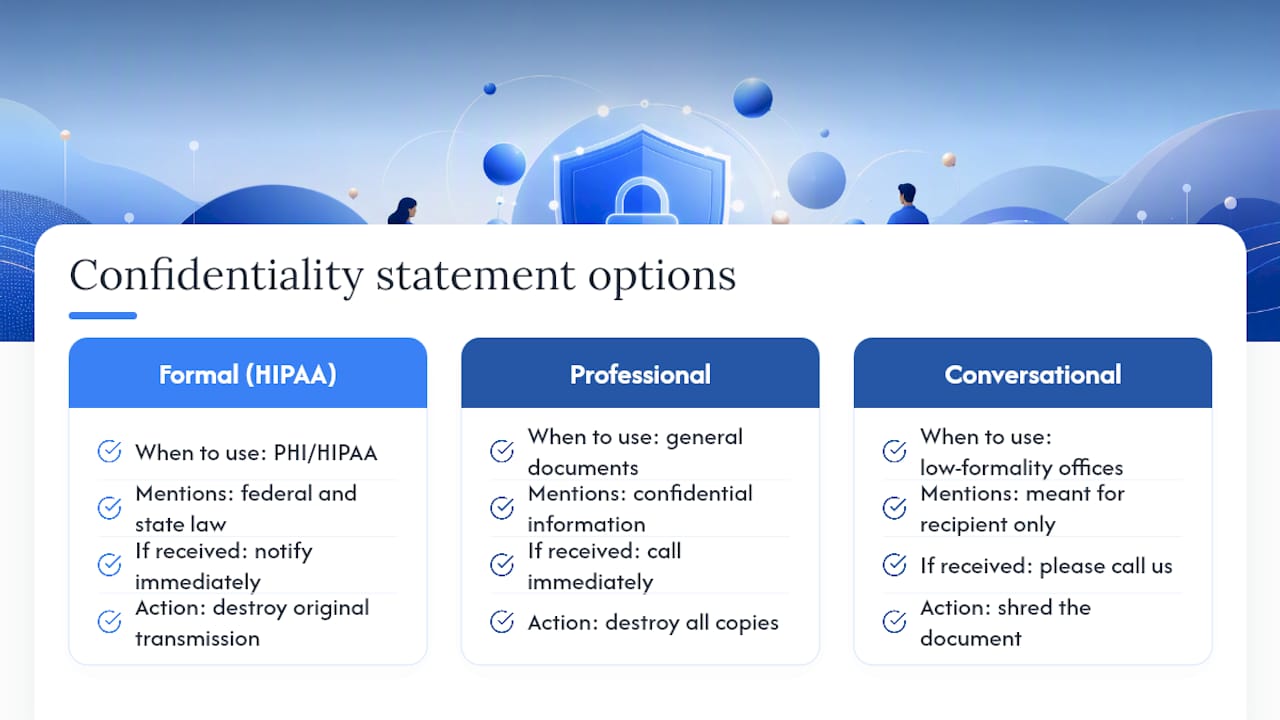
Formal, HIPAA-oriented (for PHI): “This facsimile contains confidential information protected by federal and state law, including information protected under HIPAA. It is intended only for the use of the individual or entity named above. If you are not the intended recipient, you are hereby notified that any disclosure, copying, or distribution is strictly prohibited. If you received this in error, please notify us immediately at [phone number] and destroy the original transmission.”
Professional (general confidential documents): “The information in this fax is confidential and intended solely for the recipient named above. If you received this transmission in error, please call [phone number] immediately and destroy all copies.”
Conversational (low-formality offices): “This fax is meant for [recipient name] only. Got it by mistake? Please call us at [phone number] so we can sort it out, then shred it. Thanks.”
For any of these, put the heading CONFIDENTIAL in bold above the statement, box the text if your cover sheet software allows it, and keep it at the very top of the page, before the sender and recipient fields. The free cover sheet builder at PerPageFax has this formatting built in already.
What HIPAA Actually Requires, and What a Notice Doesn’t Prove
HIPAA doesn’t specify exact cover-sheet wording anywhere in its text. What it does require is that covered entities implement reasonable administrative, technical, and physical safeguards to protect patient information, and the HHS guidance on faxing patient records treats a cover sheet notice as an accepted administrative safeguard.
That’s the key nuance most offices miss. A confidentiality statement is evidence you tried to prevent a disclosure, not proof that the transmission itself was secure. A HIPAA-compliant cover sheet template handles misdirected-recipient risk. It does nothing for transmission security, which is a separate problem solved by encryption and contractual controls.
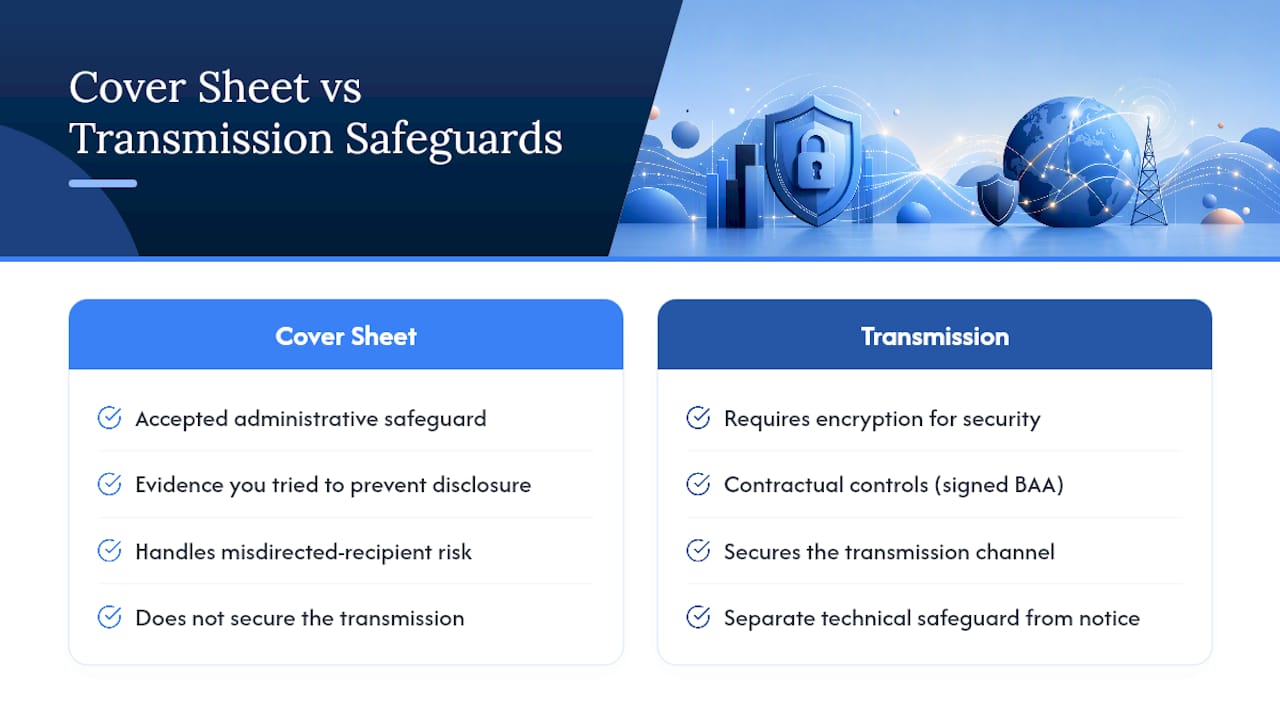
If you’re regularly faxing PHI to an outside provider or billing partner, that relationship needs a signed BAA, and the transmission itself should run through an encrypted channel rather than an unsecured analog line.
How to Cut Down Misdirected Faxes Before They Happen
Most breaches involving fax aren’t sophisticated. They’re a wrong digit dialed under time pressure. A few habits fix most of it, according to the University of Toledo’s fax safeguards policy.
- Preprogram recurring numbers into speed dial so no one retypes a ten-digit number from memory every time.
- Confirm the number verbally with the recipient before sending anything sensitive for the first time.
- Keep fax machines in a staffed, secure area, not an open hallway, and pull pages off the tray promptly.
- Turn on delivery confirmation and check the page count against what you sent.
- For PHI, use a digital fax service backed by a BAA and encryption rather than a shared office line.
Pro Tip: Build the confirmation number into your workflow, not just the cover sheet. A digital fax service with logging and confirmation catches a bad page count before you’ve walked away from the machine, not three days later.
What to Do When a Fax Goes to the Wrong Number
Mistakes happen even with good habits. What matters is how fast you act once one does.
- If you’re the sender, call the recipient immediately, ask them to destroy or return the document, and get written confirmation, even a one-line email works.
- If you’re the recipient, stop reading past the cover sheet the moment you realize it isn’t yours. Call the sender, shred the pages or confirm deletion, and send written confirmation if they ask for one.
- Either way, keep records. Save the transmission log, note the date and time you called, and file the written confirmation with the original request.
That short paper trail is usually enough to satisfy a regulator asking what happened. Vague memory of “I think I called someone” is not.
Small Formatting Choices That Make the Notice Work
A confidentiality statement buried in nine-point font at the bottom of the page gets ignored. Put it where eyes land first.
- Place it in a boxed area at the very top of the cover sheet, above the sender and recipient fields.
- Bold the word CONFIDENTIAL as a standalone heading directly above the statement text.
- State the page count as “X pages, including this cover sheet” so a partial fax is obvious at a glance.
- Use the identical template whether you’re sending from a physical machine or an online fax platform. Consistency is what makes an audit fast instead of painful.
Why Short, Plain Language Beats Legal Boilerplate
The compliance officers I’ve seen do this well don’t reach for the longest paragraph of legal language they can find. They pick one short, standardized notice and use it on every outgoing fax without exception. Wording that varies from department to department is what actually slows down an audit, because someone has to explain why three different notices exist for the same organization.
Legal or compliance teams should sign off on the template once, then leave it alone. That single review catches the language gaps that matter, like whether your organization needs a PHI-specific line, without turning every fax into a drafting exercise. Where PerPageFax fits into this is practical, not decorative: a built-in cover sheet builder paired with delivery confirmation and encryption gives you both halves of the equation, the notice and the technical safeguard, without extra software to manage.
— Engin
Send Your Next Confidential Fax Without the Hassle
Most confidential fax problems come down to two gaps: a cover sheet that’s missing the right language, and a transmission method with no confirmation it actually arrived. This service closes both without asking you to create an account or sign up for a subscription.
Build a properly formatted notice in minutes with the free cover sheet builder, which includes the boxed confidentiality heading and callback instructions already in place. Then send the actual fax through PerPageFax’s online platform at a flat $0.50 per page, no hidden fees or recurring charges, with automatic retries, encryption, and delivery confirmation so you know the document landed where it was supposed to. If you’re sending internationally, flat per-page pricing covers 35 countries too. It won’t replace a signed BAA for regulated health data, but for everyday confidential documents, tax forms, and legal filings, it’s a faster, cheaper way to get the job done right the first time. Head to the service’s website to send your fax.
Where to Find the Official Rules and Templates
For the regulatory language behind this article, go straight to the primary sources rather than a summary.
- HHS’s official FAQ on faxing patient medical information explains the administrative safeguard standard.
- UW Medicine’s fax cover sheet policy shows a working institutional template.
- Secure messaging practices in clinical settings, covered in this healthcare secure messaging guide, offer useful context for offices weighing fax against other transmission methods.
This article is general information, not legal or compliance advice. Check the official rules above and consult your compliance or legal team about your own circumstances before acting on anything here.
Sources
- HHS FAQ on faxing patient medical information
- UW Medicine fax cover sheet and policy (excerpt)
- Fax confidentiality statement: HIPAA rules and examples - LegalClarity
FAQ
What Is a Good Privacy Disclaimer for a Fax?
A good disclaimer names the intended recipient, states that the contents are confidential, and gives clear instructions plus a working callback number for anyone who receives it by mistake. The formal, professional, and conversational templates above cover most use cases and only need the bracketed fields filled in.
How Do I Write a Confidentiality Disclaimer for Documents?
Keep it to three parts: who the document is for, a statement that unauthorized use or distribution is prohibited, and what an unintended recipient should do, usually call a number and destroy the pages. The LegalClarity guide on fax confidentiality statements breaks down this exact structure.
How Do I Fax Confidential Documents Securely?
Pair a clear confidentiality notice on the cover sheet with a secure transmission method, ideally an encrypted digital fax service rather than a shared office machine. PerPageFax adds encryption and delivery confirmation on every fax sent through its online platform, which helps address risks a cover sheet alone can’t cover.
What Are the HIPAA Rules Regarding Faxing?
HIPAA requires reasonable administrative, technical, and physical safeguards for protected health information but doesn’t dictate exact cover-sheet wording, according to HHS guidance. A confidentiality notice satisfies part of the administrative safeguard expectation, while encryption and signed BAAs cover the technical and contractual side.
What’s the Difference Between a Fax Header and a Cover Sheet?
The fax header is generated automatically by the sending device and repeats on every page with the date, sender name, and sender fax number. The cover sheet is a separate, sender-written page placed on top that carries the confidentiality statement, recipient details, and page count.
Recommended
Ready to send a fax?
Send your fax online in minutes for $0.50/page — no account needed.
Send a fax now