September 9, 2026
Send a Fax From Your Browser: $0.50 Per Page
Yes, you can send a fully deliverable fax straight from your browser, with no fax machine and no subscription. Enter the recipient’s fax number, upload a PDF or image, pay per page if the service requires it, and hit send. Most one-off faxes, including IRS forms and legal filings, complete this way in a few minutes using pay-per-use online fax services.
TL;DR:
- Most online fax services support sending single or multiple pages in PDF format, with paid pay-per-use options charging around $0.50 per page.
- International faxing requires correct country codes, and file quality, especially for images, affects successful transmission, especially on mobile devices.
- Free plans often have page caps, watermarks, or lack inbound fax numbers, making paid services more suitable for frequent or business use.
- Security measures such as TLS encryption, AES storage, and HIPAA readiness are available but must be verified before transmitting sensitive or confidential documents.
- Common failures typically involve incorrect phone number formatting or connectivity issues, which often resolve with retries or correcting the input details.
How to Send a Fax From Your Browser, Step by Step
The workflow is the same whether you’re at a desktop or on your phone, and it rarely takes more than five minutes once your document is ready.
- Prepare your document. Convert or merge everything into a single PDF when you can. A PDF preserves page breaks and text clarity better than a photo or scanned image, which matters once the fax machine on the other end starts printing it.
- Enter the recipient’s fax number. For US numbers, include the area code. For international faxes, add the correct country code before the number, since a missing dial prefix is one of the most common reasons a fax bounces back as undeliverable.
- Upload your files and add a cover sheet. Most browser tools let you drag and drop a file directly into the page. A short cover sheet with your name, date, and page count helps the recipient’s office route the fax correctly.
- Pay if required, then send. Pay-per-page services charge at checkout with no account needed. Watch the live status indicator or check your email for a delivery receipt once transmission finishes.
If you’re on a phone, snap a photo of a paper document, upload it directly, and fax from browser the same way you would from a desktop. Image quality matters more here, so hold the camera steady and avoid shadows across the page.
Pro Tip: Name your file clearly before uploading (like “IRS_Form_2848.pdf”) so if you need to contact support about a failed send, you can identify it instantly.
What to Expect: File Types, Page Limits, and Coverage
PDF is the preferred format for online faxing because it locks in page breaks and resolution the way the receiving fax machine expects. JPG and PNG work fine for single pages or photographed documents, but multi-page scans as separate images tend to arrive out of order or get rejected outright.
Here’s what shapes a typical browser fax session:
- Free tiers commonly cap sends at a handful of pages per day or per account, and some require sign-up before you can send anything at all.
- Paid, pay-per-use tools skip the account requirement entirely and charge per page instead.
- Most browser-based fax platforms support sending to 50 or more countries, provided you include the correct international dialing prefix, a workflow Browserfax also offers alongside its browser-first upload process.
- Multiple files usually combine into one transmission if the service allows batch uploads, though single-PDF submissions fail less often.
Receiving a fax is a different animal. Sending only needs a recipient number, but receiving inbound faxes requires a dedicated fax number assigned to you, which is typically a subscription feature rather than something a pay-per-use send unlocks.
Pay-Per-Fax or Subscription: Which Costs Less?
The math is simple once you know your volume. A flat rate of $0.50 per page means a five-page IRS form costs $2.50 with no monthly commitment and nothing to cancel later.
Free plans look appealing until you read the fine print:
- Daily or total page caps that block longer documents.
- Watermarks stamped across the page, which some government and legal recipients reject outright.
- No inbound fax number, so you can send but can’t receive replies.
Reviewers at PCMag note that free options often carry strict page limits and account requirements, while paid services lean on transparent, flat pricing instead. A subscription starts making sense only when you need a permanent local fax number, regular inbound traffic, or team accounts for a business handling faxes daily. For a single urgent form, pay-per-use avoids paying for a service you’ll use once.
Before you commit to any recurring plan, check the billing page for auto-renewal terms and confirm whether failed sends trigger a refund or just vanish into a support ticket queue.
Is It Safe to Fax Sensitive Documents From a Browser?
Security comes down to a short checklist you can verify before you upload anything sensitive. Confirm the service encrypts your file in transit with TLS and, ideally, encrypts stored files with AES, the same standard security roundups point to when evaluating fax platforms for confidential documents.
For regulated work like medical records, ask whether the provider offers a HIPAA-ready configuration or a signed business associate agreement (BAA). Most one-off legal or tax filings don’t require that level of documentation, but it’s worth checking if you’re faxing on behalf of a healthcare practice.
Beyond encryption, look for:
- A delivery log or signed receipt you can save for your own records.
- The option to password-protect a PDF before uploading it.
- Clear indication that files aren’t retained longer than needed for transmission.
Pro Tip: If a document contains a Social Security number or financial account details, redact anything not strictly necessary for the recipient before you upload it. A fax that fails to redirect internally is still a document sitting somewhere.
Troubleshooting Common Fax Failures
Most failures fall into three buckets: a busy or unreachable line, an invalid number format, or a file the service can’t process.
- Read the failure message first. “Busy” usually means the retry will succeed on its own. “Invalid number” almost always means a missing country or area code.
- Fix formatting issues. Convert multi-file uploads into a single PDF, and if an image looks too large, lowering its resolution can resolve upload errors.
- Double-check international prefixes. Re-enter the country code exactly as required, since a dropped digit here is the most common cause of silent failures.
- Let automatic retries work. Many services retry a failed number several times before marking it undeliverable, and some issue a refund automatically if the fax never goes through.
Before contacting support, gather the send time, the recipient’s fax number, and the file name. That’s usually all a support team needs to trace what happened.
When Browser Faxing Is Actually the Right Tool
Browser faxing earns its place for exactly the situations most people actually face: a one-off IRS form, a signed contract that needs to reach a law office today, or a permit application with a deadline in an hour. Wirecutter’s reporting backs this up, noting that for most people, online faxing has fully replaced the physical machine.
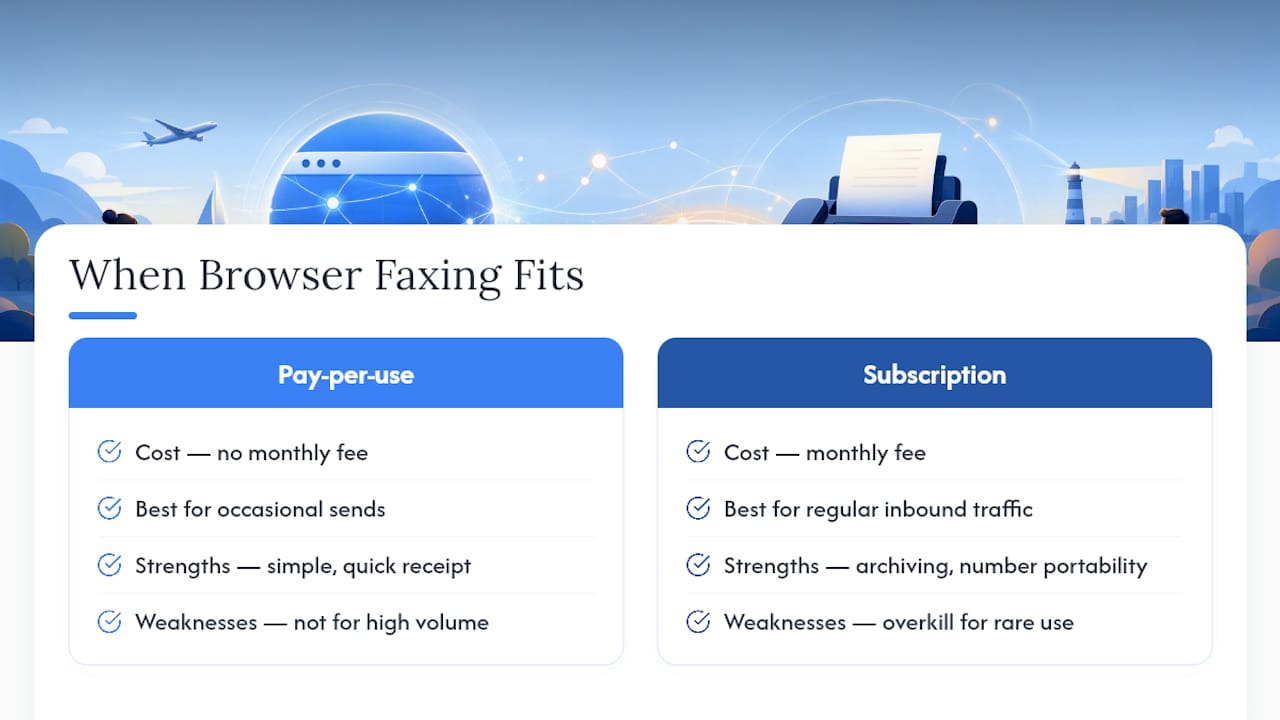
Where it falls short is volume. If you’re faxing dozens of documents a week or need a permanent number for inbound replies, a subscription earns its cost through archiving and number portability that pay-per-use tools don’t offer. For everything else, the trade-off favors simplicity: no account, no monthly fee, and a receipt in your inbox within minutes.
My take: default to pay-per-use for anything you’ll do once or twice a year. Reserve a subscription for regular inbound traffic or a dedicated business line.
— Engin
Send Your Fax Now for $0.50 a Page, No Account Required
Skip the account creation and skip guessing whether a free tier’s page cap will cut off your document halfway through. Perpagefax charges a flat $0.50 per page, supports PDF, JPG, and PNG uploads, and confirms delivery with a status update so you’re not left wondering if your IRS form actually arrived.
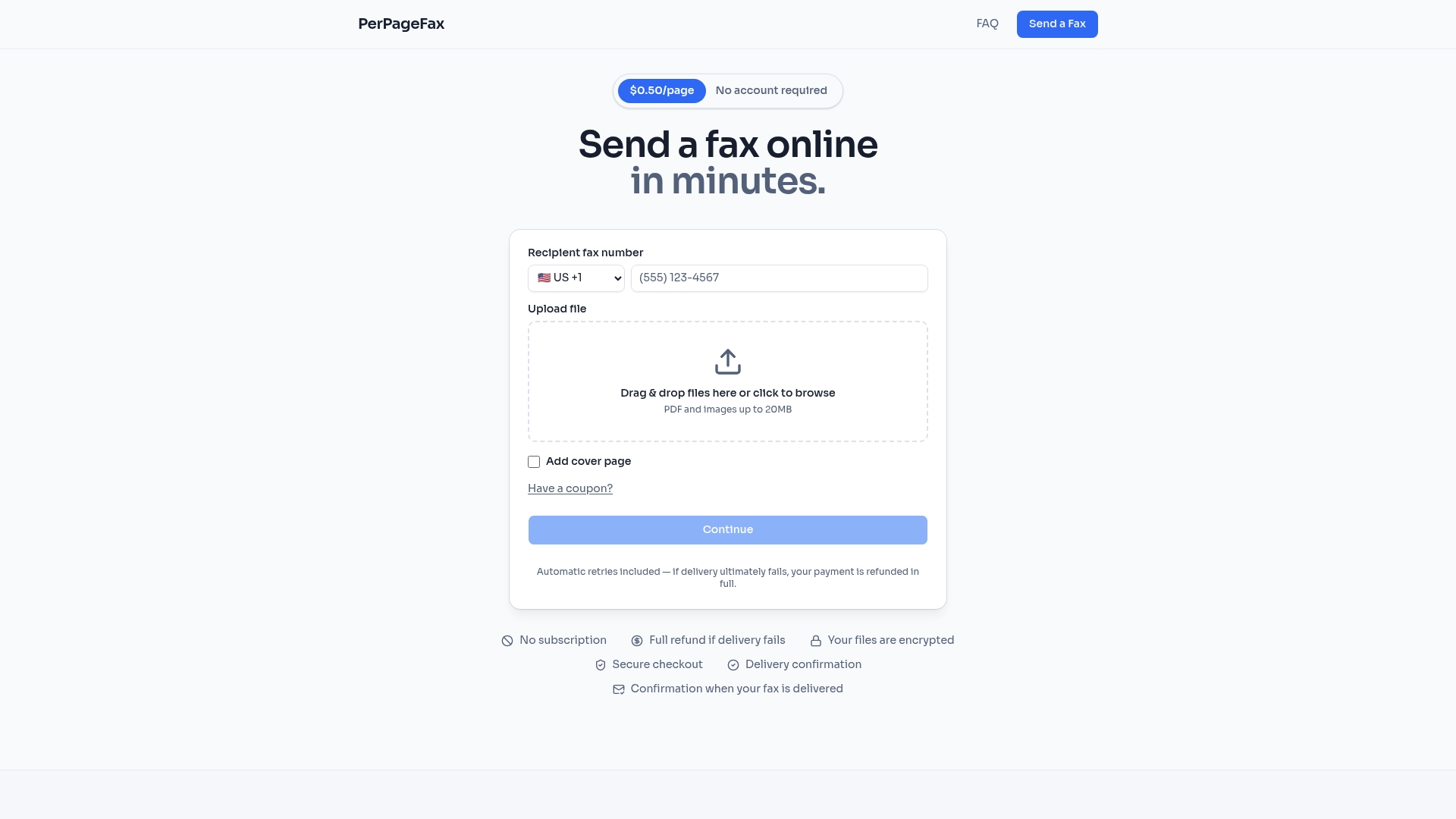
Every send runs over encrypted transmission, and failed faxes retry automatically before anything gets marked undeliverable. If a fax truly can’t complete, the charge is refunded rather than absorbed silently. Need a cover sheet first? Build one free with the cover sheet builder, or run a scanned document through the PDF faxify tool to make sure it transmits cleanly before you pay. Head to the Perpagefax landing page and get your document sent in the next few minutes.
Sources
- The Best Online Fax Services We’ve Tested for 2026 | PCMag
- The Best Online Fax Services | Wirecutter
- 6 Best Online Fax Services for Secure File Sharing in 2026
Recommended
Ready to send a fax?
Send your fax online in minutes for $0.50/page — no account needed.
Send a fax now