September 8, 2026
Fax Receipts for Audits: Keep Proof 3–7 Years
A fax confirmation shows your fax machine or online service successfully transmitted data to the recipient number, not that a person actually read the document. Get one from a physical machine as a printed transmission report, or from an online fax service as a digital receipt. For critical deadlines, back it up with a phone call or certified mail.
TL;DR:
- Fax confirmations verify only that data was transmitted successfully between machines, not that the recipient read or opened the document.
- To ensure proof, always enable print-on-every transmission on physical machines and verify page counts, timestamps, and status codes match the original send.
- Digital fax services provide email or downloadable PDFs as confirmations, which should be downloaded and stored immediately for legal and audit purposes.
- Errors on confirmation reports often result from mistyped numbers, line issues, or faint barcodes, requiring resending specific pages or fixing scanning resolutions.
- Keep all fax confirmations, whether printed or digital, with the related documents and include clear notes to protect against disputes or legal challenges.
What Is a Fax Receipt, and Why Does It Matter?
A fax confirmation goes by several names: fax confirmation page, transmission verification report, or simply a fax receipt. Whatever the label, it documents that data moved successfully from your machine to the recipient’s line.
Businesses keep these confirmations for a reason. Healthcare offices need them for HIPAA-related record trails. Law firms rely on them to prove timely filing. Accountants use them to close out audit documentation on deadline. The confirmation becomes part of the paper trail that shows you did your part.
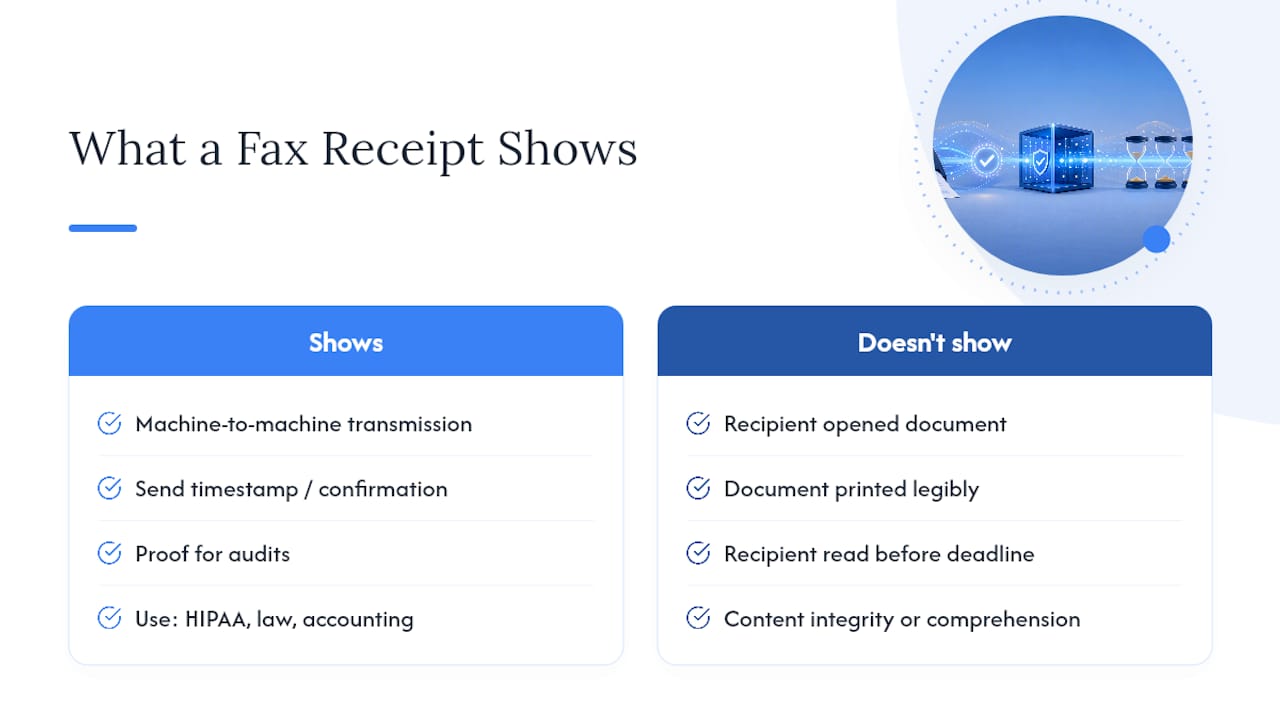
Here’s the catch worth remembering: a confirmation proves your machine talked to the recipient’s machine. It says nothing about whether someone opened the document, printed it clearly, or read it before a deadline passed. That gap matters more than most people realize until a dispute forces them to explain it.
What Fields Appear on a Fax Confirmation?
Every standard confirmation carries the same core data, whether it prints from a desktop machine or arrives as a PDF from a cloud service. Reading it correctly means checking more than just a stamp that says “sent.”
- Sender and recipient numbers — confirms you dialed the right line
- Date and time — establishes exactly when transmission occurred
- Page count — shows how many pages actually transmitted, not just how many you fed in
- Duration — a page transmission that finishes too fast often means a dropped or blank page
- Status/result code — typically OK, NG (no good), or a specific error code
- Transmission ID — a reference number for tracking or disputes
Statistic to remember: according to Brother’s help documentation, the transmission verification report (TVR) lists the recipient number, timestamp, and page count automatically whenever the feature is enabled. If your page count on the confirmation doesn’t match what you fed the machine, that’s your first sign something got dropped mid-transmission.
How Do You Print a Fax Confirmation From a Physical Machine?
Most desktop fax machines and multifunction printers default to printing a report only when a transmission fails. That default works against you if you need proof of every successful send.
- Open your device settings and locate the fax or communication menu.
- Switch the report setting from “error only” to “print on every transmission,” sometimes labeled transmission verification.
- Send your fax as usual, then wait for the automatic printout, or trigger it manually if your model requires that.
- Check the printed report against your document: page count, duration, recipient number, and status code should all line up.
- For barcode cover sheet workflows, such as expense imaging systems, confirm the barcode printed clearly and that the cover sheet was the first page fed.
Brother’s device documentation recommends enabling print-on-success specifically because relying on the “errors only” default means a successful fax leaves no paper trail at all.
Pro Tip: Set your fax machine to fine resolution before sending anything with small text or barcodes. A blurry cover sheet barcode can cause an entire imaging workflow, like an expense system, to reject the submission even though the fax itself went through fine.
How Do Online Fax Services Deliver Confirmations?
Cloud-based fax platforms handle confirmations differently than desktop machines, and the difference works in your favor if you know where to look. Instead of a single paper printout, you typically get one or more of these:
- An immediate email notification with the confirmation attached as a PDF
- A downloadable record sitting in your account’s sent-folder or dashboard log
- Metadata fields (timestamp, recipient number, status) attached to that record for later reference
The catch: many services notify you only when a fax fails, not when it succeeds, according to mFax’s overview of fax confirmation pages. Check your notification settings before you assume silence means success. If you’re new to sending faxes digitally, a guide to sending a fax online walks through the setup end to end.
Once you have a digital confirmation, download the PDF and store it with a clear file name, something like the date, recipient, and transmission ID. That habit alone makes retrieval far easier if you’re ever asked to produce proof months later.
Why Did My Fax Confirmation Show an Error?
A status code of “NG” or an unfamiliar error number usually points to one of a handful of common causes: a mistyped number, a busy line on the recipient’s end, poor line quality, low toner obscuring the printed report, a paper misfeed, or a barcode that printed too faintly to scan.
- Check your sent log first. Confirm the number you dialed matches the intended recipient exactly.
- Resend just the failed pages rather than the whole document if only part of the transmission dropped.
- Bump the resolution setting up if text or barcodes came through unreadable.
- For cover sheet workflows, verify the barcode is sharp and that the cover sheet fed first, since a faint barcode is enough to break automated processing in systems like SAP Concur’s expense imaging workflow.
- Call the recipient directly to confirm receipt when the stakes are high, and don’t rely on a single retry.
If a deadline is involved, resend immediately and follow up with certified mail as a fallback rather than assuming a second attempt will clear things up on its own.
Does a Fax Confirmation Count as Legal Proof?
Courts generally treat a fax confirmation sheet as admissible evidence, often under the business records exception to hearsay rules. It documents that your machine transmitted successfully to the receiving number.
That said, admissible does not mean unbeatable. According to LegalClarity’s analysis of fax confirmation sheets, a confirmation shows machine-to-machine transmission, not that a specific person read the document. If it later turns out the recipient’s machine was broken or you dialed a discontinued number, that confirmation alone may not establish effective service.
The legal precedent behind fax-based service further backs this caution: Cornell’s Legal Information Institute notes that service by fax can be recognized under federal rules, but service can still fail if the sender later learns the transmission never reached the intended party.
On retention, treat confirmations the way you’d treat other business records:
- Keep tax-related fax confirmations for the same period you retain other IRS documentation, commonly three to seven years depending on the filing type.
- Retain legal or contractual confirmations for as long as the underlying statute of limitations applies to that matter.
- Scan any thermal paper confirmation immediately. Thermal receipts fade over time and can become illegible well before your retention window closes.
How Do You Save or Convert a Fax Confirmation for Records?
Preservation is where most people cut corners, and it’s exactly where disputes get decided. A few habits close that gap.
- Scan paper confirmations the same day you receive them, and save the PDF with a file name that includes the date, recipient, and transmission ID.
- Download or export digital sent-folder PDFs immediately rather than trusting they’ll stay accessible indefinitely in your account.
- Save the full email header alongside any emailed confirmation. Microsoft’s guidance on Outlook delivery receipts notes that headers carry timestamp and routing data that matters for chain-of-custody purposes.
- If the original is missing, a screenshot showing full headers, or a request to your fax provider for its server log, is often the next-best evidence.
Pro Tip: Store the confirmation with the transmitted document itself, not in a separate folder. When someone asks for proof six months from now, you want both pieces to surface together without a search.
Workflow Notes From Handling Fax Disputes
The businesses that never get burned by a fax dispute all do one thing: they save the confirmation alongside the document, with a one-line note on what it was for and when. That habit costs seconds and saves hours later.
For anything deadline-sensitive, a confirmation by itself is a thin shield. Pair it with a phone call or certified mail. Digital receipts consistently beat paper ones for audits, since they carry searchable metadata a thermal printout never will.
— Engin
Send Faxes With Automatic Digital Confirmations
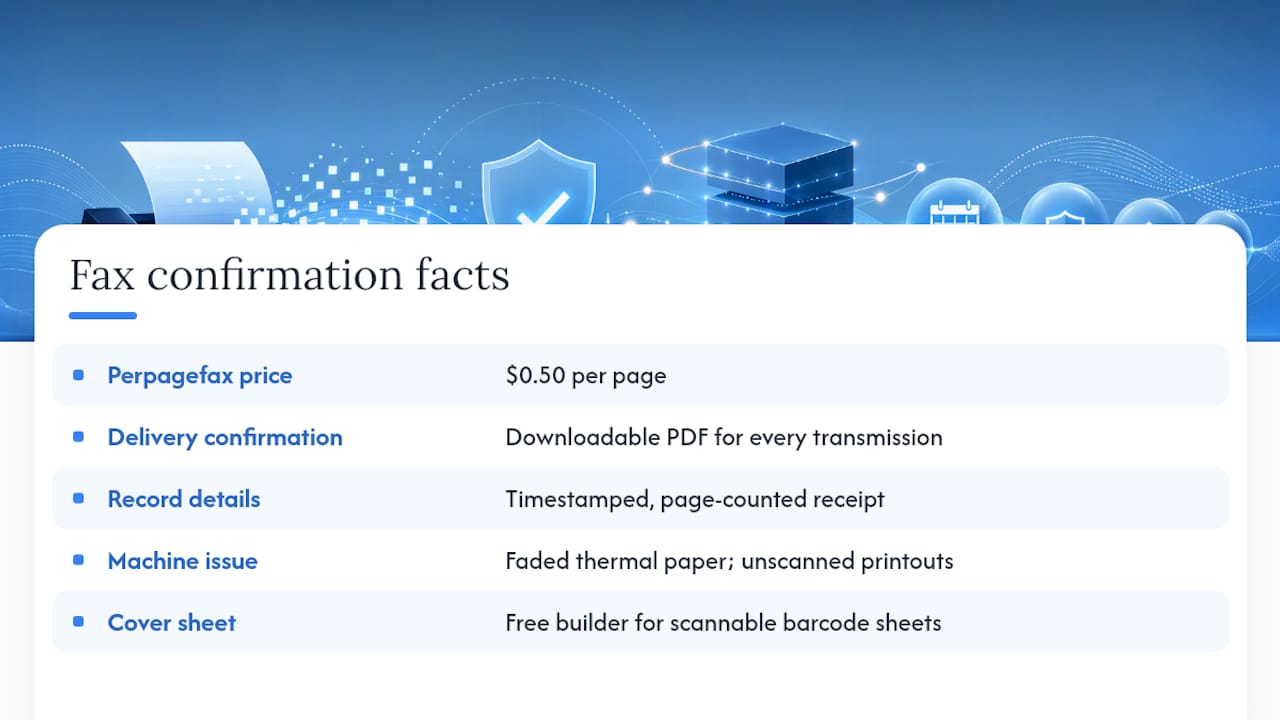
Skip the machine altogether and you skip most of what makes confirmations unreliable, the faded thermal paper, the “errors only” default, the printout nobody scanned in time. Perpagefax sends faxes online for a flat $0.50 per page, with no account or subscription required, and every transmission comes with a delivery confirmation you can download as a PDF.
That structure maps directly onto what this article covers: a timestamped, page-counted record you can file next to the original document without hunting for a sent-folder login months later. It works for IRS forms, legal filings, or any document where you need a receipt that still reads clearly years from now. If your workflow involves barcode cover sheets for expense systems, the free cover sheet builder generates a clean, scannable page in minutes.
Send your next fax and download the confirmation the moment it completes.
Sources
- Transmission verification report (TVR) — Brother USA help
- Fax receipt images for an invoice — SAP Concur help
- Fax confirmation sheet: what it proves and how to get one — LegalClarity
Recommended
Ready to send a fax?
Send your fax online in minutes for $0.50/page — no account needed.
Send a fax now