September 19, 2026
How Long Does a Fax Take? Real Timings
A text-only page takes about 30 to 60 seconds on a traditional fax machine, while pages with graphics or fine detail can run several minutes each. Online fax services skip most of that delay: a multi-page PDF often uploads and delivers in seconds to a few minutes total, regardless of page count.
TL;DR:
- Traditional fax machines can take 30 to 60 seconds per text page, but graphics and fine details can extend transmission times to several minutes per page.
- Online fax services often upload and transmit entire documents in seconds to a few minutes, regardless of page count, by skipping the handshake process.
- Receiving a fax on a traditional machine depends on line availability, potentially causing delays, while online services instantly deliver incoming faxes to a digital inbox.
- Factors such as high-resolution images, line quality, and busy signals significantly slow down transmission, with baud rate and content complexity being primary determinants.
- Preparing concise documents, choosing online services for multi-page files, and verifying recipient numbers improve speed and reliability, especially for legal or urgent documents.
How Long Does a Fax Take? The Basics of Traditional vs. Online
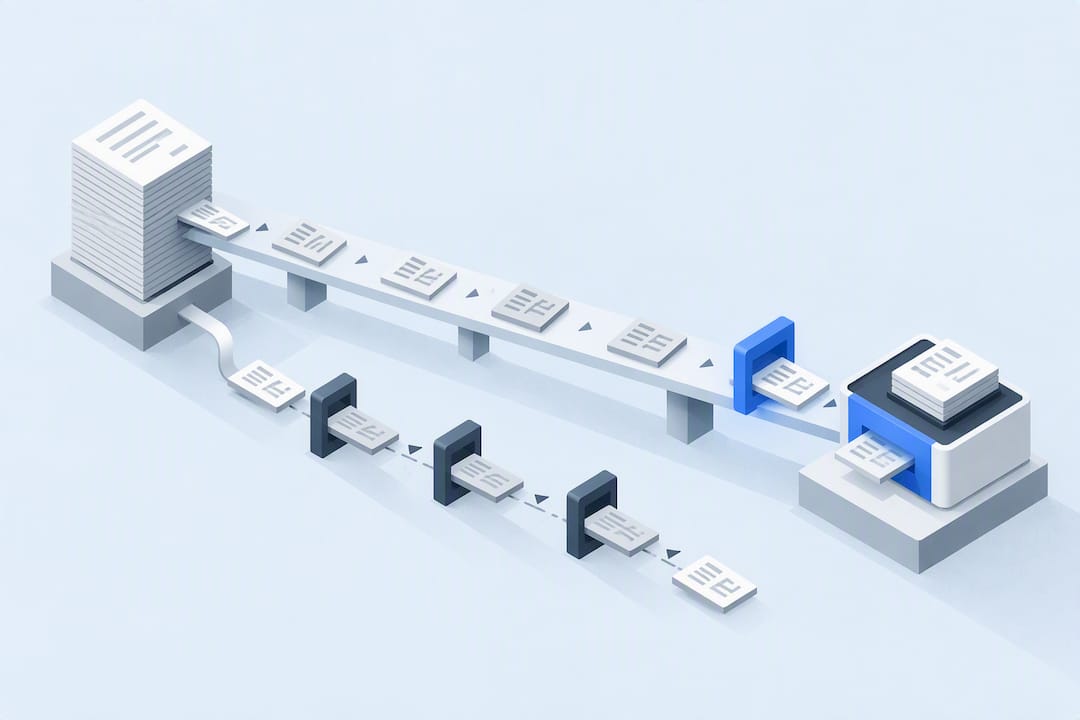
A traditional fax machine spends time on three things: dialing, a handshake, and per-page transmission. The handshake, governed by the ITU-T T.30 and T.4 standards that define Group 3 fax behavior, negotiates the connection speed and image resolution before a single page moves. Once connected, the machine scans, compresses, and modulates each page over a phone line at a fixed baud rate, which is why raw transmission runs roughly 6 to 15 seconds per page but often stretches to 30 to 60 seconds once compression and line conditions are factored in.
Online services skip the handshake almost entirely. You upload a PDF once, and the service transmits it as a batch rather than negotiating a new connection for every page. That single difference is why online faxing scales so much better on longer documents. Most of the time savings come from removing repeated setup, not from making each page transmit faster.
How Long Does It Take to Send a Fax? Per-Page and Multi-Page Timelines
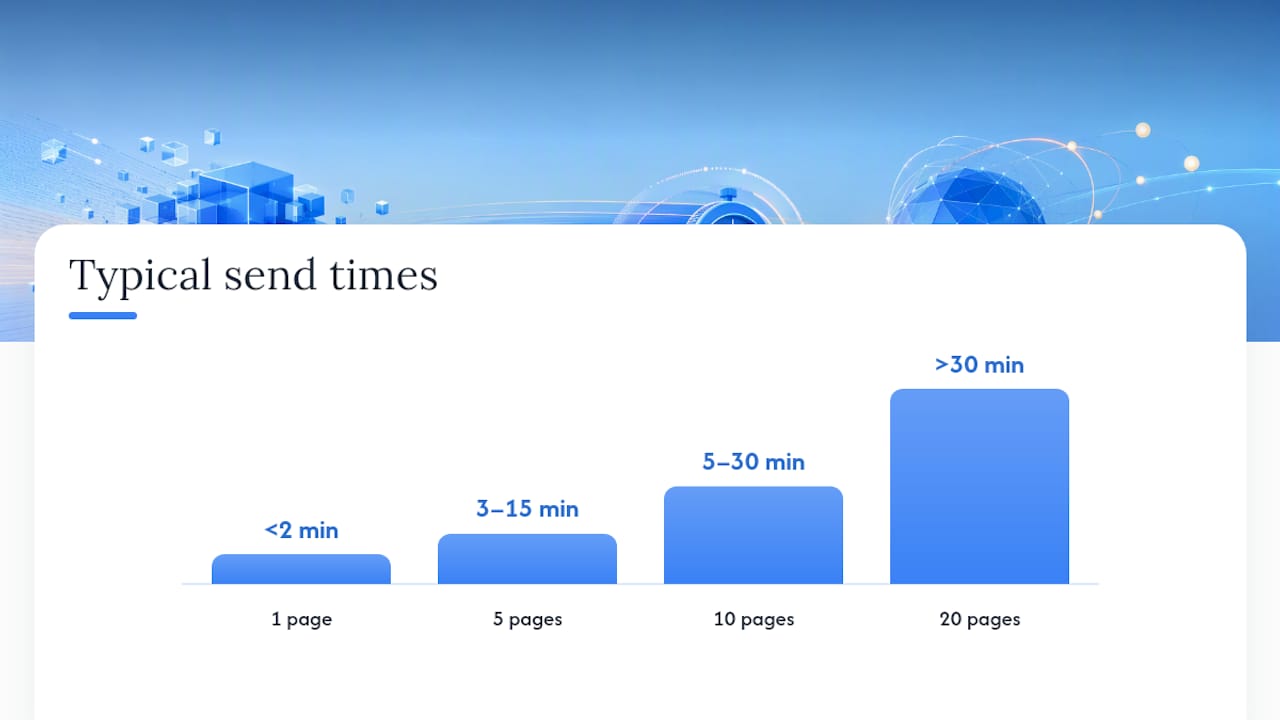
Here’s what actually determines your total send time, and what to expect for common document lengths.
Per-page ranges under normal conditions:
- Text-only page, traditional machine: about 30 to 60 seconds
- Text-only page, Group 3 standard: 10 to 60 seconds depending on resolution and connection quality
- Graphics, photos, or fine detail: up to several minutes per page
- Online upload, per document (not per page): seconds to a few minutes total, regardless of page count
Sample totals reported by industry timing guides show 1 page finishing in under 2 minutes, 5 pages taking 3 to 15 minutes, and 10 pages running 5 to 30 minutes on a traditional machine. A 20-page document can stretch past 30 minutes once you add dialing time and any retries. An online service handling the same 20-page PDF typically finishes the whole job in the time it takes to upload the file, since there’s no per-page dial-up cycle to repeat.
How Long Does It Take to Receive a Fax?
Receiving works differently depending on the destination. A traditional machine needs a free phone line at the exact moment the fax arrives. If that line is busy, the sending machine retries automatically, which adds delay measured in minutes, not seconds.
Online fax services remove that bottleneck. Incoming faxes land in a digital inbox the moment they’re received, whether or not anyone is watching for them. You retrieve the document on your own schedule instead of waiting by a machine. Delivery confirmation and status logs give you the exact timestamp a fax was accepted by the receiving line, which matters when you need proof a document arrived by a certain time, not just an estimate.
What Slows Down a Fax? Key Factors to Check
Most delays trace back to a handful of variables you can actually diagnose:
- Content type: Text transmits fast; photos, dense graphics, or fine print force higher resolution scanning and slow everything down.
- Resolution and compression settings: Higher resolution means more data per page, which means more transmission time.
- Line quality and baud rate: Transmission speed depends heavily on baud rate, and a slower or noisier line forces both machines to negotiate a reduced speed.
- Busy signals and international routing: A busy line triggers automatic retries, and international numbers often add routing delays.
- Recipient hardware problems: Paper jams, low toner, or a machine that’s simply off can stall delivery indefinitely on the receiving end.
Statistic to remember: industry help centers consistently point to baud rate and document content as the two factors that most directly control transmission time, ahead of anything else on this list.
How to Speed Up a Slow or Failed Fax
Most slow transmissions are fixable before you ever hit send.
- Optimize the document first. Convert to a monochrome PDF, crop unnecessary margins, and lower image resolution where detail doesn’t matter.
- Choose an online service for anything longer than a page or two. Batch upload avoids the repeated handshake that makes multi-page phone faxes drag.
- Double-check the recipient’s number and send during off-peak hours if you’ve hit busy signals before.
- Use delivery confirmation so you know the transmission succeeded instead of guessing.
- If a fax fails, check the log first. Most services show exactly where the transmission broke down, which tells you whether to retry or pick up the phone.
Pro Tip: A PDF cleaned up with a tool like PerPageFax’s Faxify PDF tends to transmit faster and fail less often than a scanned image straight from a phone camera.
When Every Minute Counts: Legal and Time-Sensitive Faxes
Court filing deadlines, IRS submissions, and medical records transfers all share one trait: a late fax can cause real damage, not just inconvenience. For these, delivery confirmation and a timestamped receipt aren’t optional extras. If a deadline is tight, don’t rely on a single attempt. Confirm receipt with the recipient directly when the stakes are high, and keep a backup method ready in case the primary line is busy.
How Online Fax Features Cut Total Delivery Time
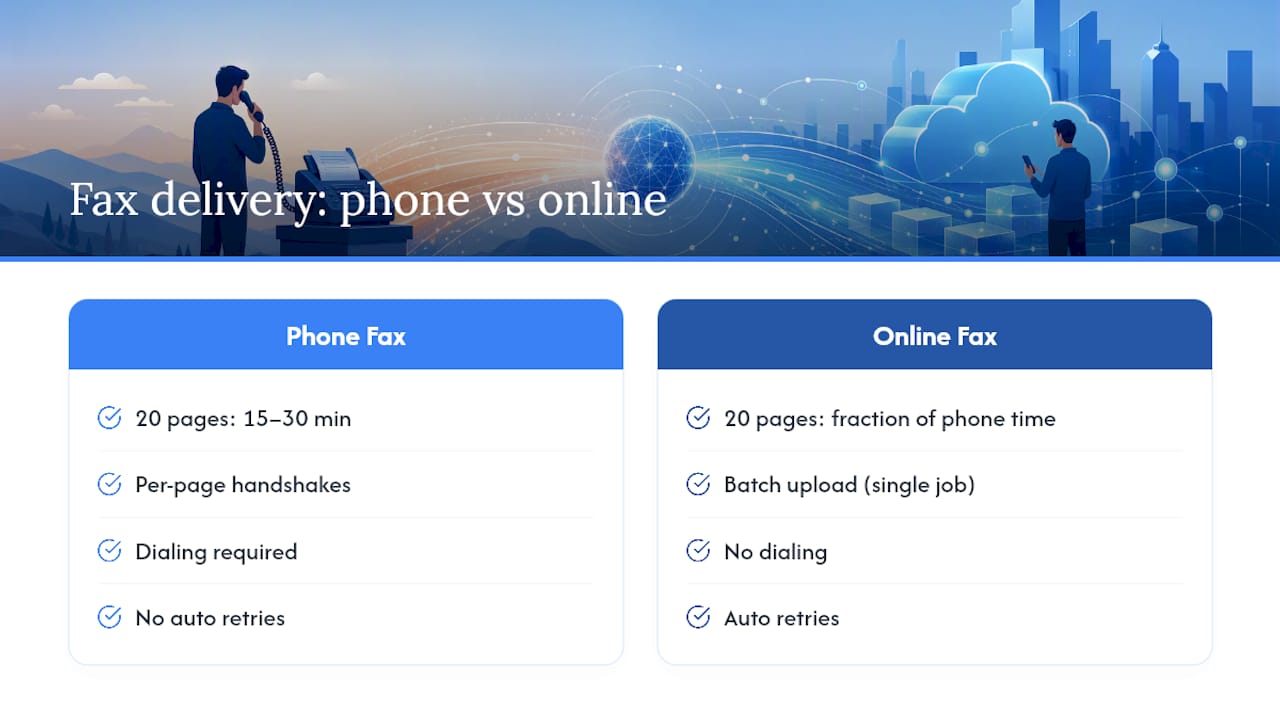
Batch upload is the biggest lever here. A 20-page document sent over a traditional phone line can take 15 to 30 minutes once dialing and per-page handshakes stack up. The same 20-page PDF uploaded to an online service transmits as one continuous job, often finishing in a fraction of that time. Automatic retries handle busy signals or dropped connections without you lifting a finger, and delivery confirmation gives you a timestamp the moment the fax lands. These aren’t convenience features. They’re what turns an unpredictable phone-line process into something closer to sending an email.
Choosing the Fastest Method for Your Fax
A single, short text page rarely justifies switching tools. A machine handles that fine in under a minute. The math changes once you’re sending anything longer or anything with graphics, since per-page handshake delays compound fast.
For urgent legal or tax documents, weigh cost-per-page against the value of your time and the risk of a missed deadline. Before you send: confirm the recipient number, clean up the document, and pick the method that matches how much is riding on delivery speed.
— Engin
Send Faxes Faster Without the Machine
An online fax service is built for exactly the moment a traditional fax machine slows you down: an urgent multi-page document with no time for repeated handshakes or busy signals. Such services typically allow sending without an account or subscription, with a transparent per-page pricing model. You upload your PDF, and the batch transfer skips the per-page dial-up delay that stretches out traditional sends.

Automatic retries handle connection hiccups on their own, and delivery confirmation gives you a timestamp the moment your fax goes through. That combination makes it a strong fit for IRS forms, legal filings, or any document where you need proof of delivery, not just a guess. If you’re sending internationally, PerPageFax covers 35 countries at the same flat rate. When you’re ready, head to PerPageFax’s sending page and upload your document to get it moving.
Sources
The per-page and multi-page estimates in this article draw on Wikipedia’s technical overview of fax standards, FaxFlow’s timing breakdown, Fax Authority’s help center guidance, and Alohi’s explanation of baud rate and content factors.
FAQ
Why Is My Fax Taking So Long to Send?
The most common causes are high-resolution graphics, a slow or noisy phone line, or a busy signal forcing retries. Text-only pages on a healthy line should transmit in 30 to 60 seconds, so anything far slower usually points to one of those three issues.
Is It Quicker to Fax or Mail a Document?
Faxing is almost always faster than mail, since even a slow traditional fax delivers in minutes rather than days. Online services close that gap even further, often delivering multi-page PDFs in under a minute total.
Do You Receive a Fax Immediately?
On a traditional machine, a fax only arrives if the phone line is free at that moment. Online fax services queue incoming faxes and deliver them to your inbox as soon as they’re received, so retrieval time depends only on when you check it.
How Do I Know If a Fax Was Successfully Sent?
Delivery confirmation and status logs give you a definitive timestamp showing whether the transmission completed. Some online fax services include this feature automatically, which removes the guesswork traditional machines leave you with.
Recommended
Ready to send a fax?
Send your fax online in minutes for $0.50/page — no account needed.
Send a fax now