September 10, 2026
How to Fax from Computer Without a Phone Line
The deadline is today. A government office or court has given you a fax number, the document is sitting on your laptop, and the only machine nearby belongs to another decade. You don't need to find a landline, install a modem, or buy a fax machine. A browser-based service can turn a PDF or phone scan into an outbound fax, but the important part isn't clicking Send. It's preparing the file correctly, checking recipient requirements, and verifying that the destination device accepted the transmission.
Why You Can Fax from Computer Today
Internet faxing moved the access point from a dedicated machine and phone line to a computer, browser, or mobile device. You upload a document, enter the destination, pay for the transmission when required, and receive a record of what happened. The receiving side may still use a traditional fax machine or an online fax system, but you don't need to manage that hardware yourself.
That shift matters because faxing never disappeared from institutional workflows. A widely cited industry estimate reports that more than 17 billion individual faxed documents were sent in the United States in 2019, with healthcare accounting for more than 9 billion pages of that total, as documented in fax usage statistics from FaxSIP. The historical change wasn't the elimination of fax. It was the replacement of the physical sending point with software, web portals, and email-connected workflows.
Germany shows the same institutional persistence. Bitkom reporting says 95% of companies used fax in 2018, compared with 92% in 2020, 88% in 2022, 82% in 2023, and 77% in 2024. The 2024 report also says 25% of companies used fax frequently or very frequently, according to Silicon Saxony's summary of the Bitkom data. Those figures don't mean fax is the right channel for every document. They do explain why courts, agencies, insurers, and regulated businesses still publish fax numbers.
The practical workflow
A reliable computer fax usually follows this sequence:
- Prepare the source file: Use a legible PDF or supported image, check the page order, and remove accidental blank pages.
- Add the right cover information: Include sender details, recipient details, page count, and any case or reference number the recipient requires.
- Upload and address it: Select the destination country, enter the complete fax number, and review every digit.
- Pay and submit: Accountless services may process payment by card without requiring recurring billing.
- Monitor the transmission: Open the unique status page, wait for a delivered result, and save the confirmation.
You can find a broader explanation of why a landline isn't necessary in this guide to modern fax options. The key reassurance is simple: the hardware problem is solved. Your responsibility is making sure the document and recipient details are correct, then confirming the receiving device reported success.
Preparing Your Documents and Cover Page
The fax service can transmit a badly prepared document perfectly. That still leaves you with a rejected filing, an unreadable signature, or a cover sheet that failed to identify the case. Prepare everything before opening the upload page so you can spend the deadline checking content rather than troubleshooting file errors.
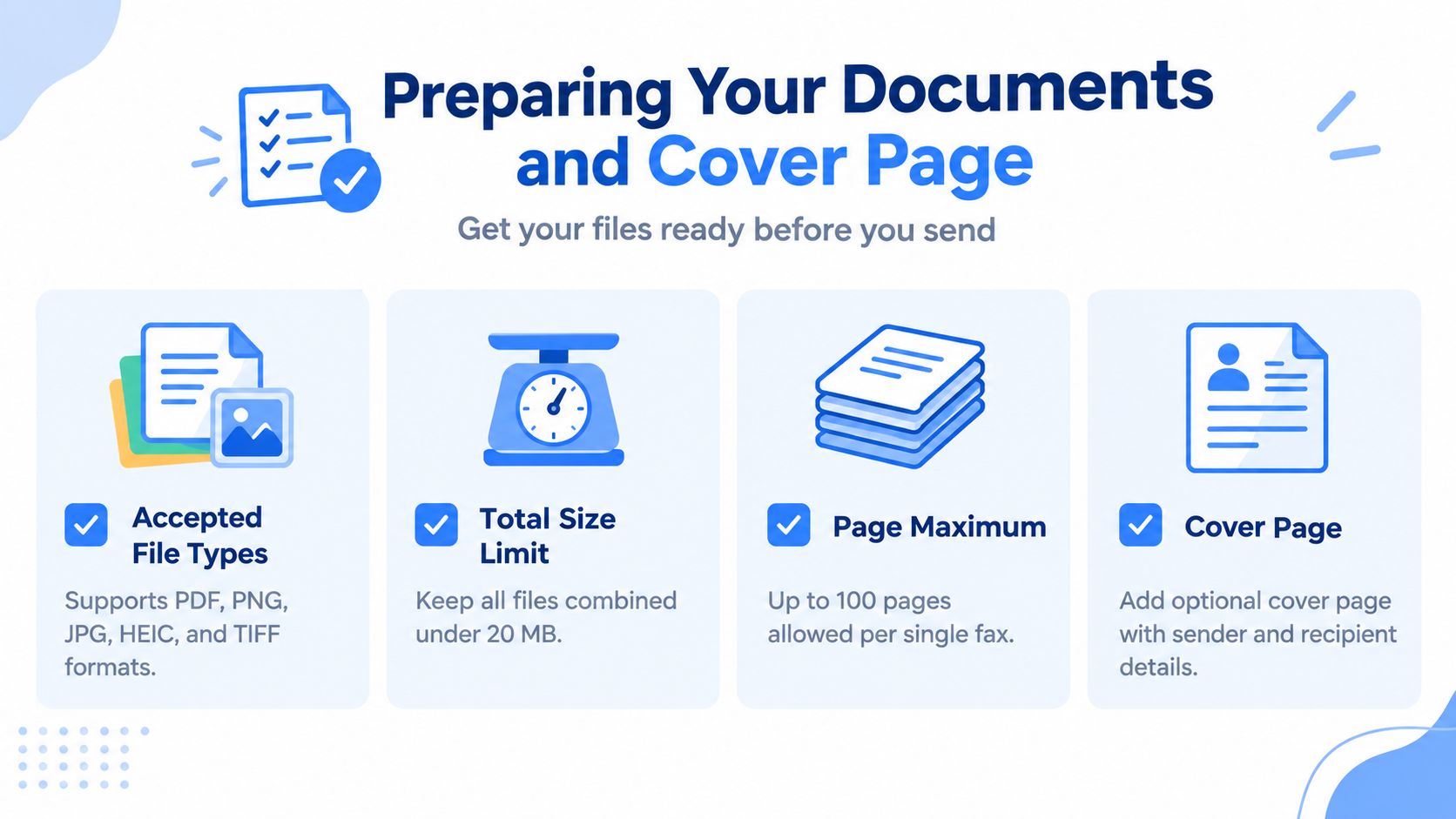
PerPageFax accepts PDF, PNG, JPG, HEIC, and TIFF files, with a 20 MB total limit and a maximum of 100 pages per transmission, according to the publisher's service information. A PDF is usually the safest choice because it preserves page order and placement. HEIC is useful when you're sending a recent iPhone photo, but convert it to PDF if the recipient's office has warned that its system can't open image attachments or if the photographed pages need consistent sizing.
A clean file beats a fast upload
If the document exists only on paper, use your phone's scanning mode rather than an ordinary camera setting. Place the page on a flat, contrasting surface, keep the camera parallel to the paper, capture all four edges, and check that small print and handwritten signatures remain readable at normal zoom. Convert multiple images into one PDF when possible, then open the final file and inspect every page in sequence.
Before uploading, check:
- Page order: Put exhibits, attachments, and signature pages where the recipient expects them.
- Orientation: Rotate wide-format pages so they don't arrive sideways or clipped.
- Contrast: Avoid shadows across signatures, stamps, and form fields.
- Margins: Make sure text isn't pressed against an edge that could disappear during transmission.
- Filename: Use a clear name containing the sender or matter reference, without relying on a filename alone to identify the submission.
A cover page is optional for many ordinary business faxes, but it's a sensible control for legal, tax, and government documents. Include the sender's name, organization, phone number, fax number if available, recipient's name or department, destination fax number, transmission date, subject, and total page count. Don't put sensitive details in a casual message that isn't needed for routing.
Legal offices may impose their own cover-sheet rules. Washington State court rules, for example, require a fax transmittal sheet in a prescribed format, including the case number, case caption, number of pages, sender's name, voice and facsimile telephone numbers, and fax fee remittance certification, as stated in the Washington court rule on fax transmissions. For a reusable layout, see this fax cover sheet resource. Teams handling sensitive matter files should also review practical guidance on security for legal document workflows, especially around access, retention, and confirmation records.
Uploading and Sending Your Fax Online
Once the file is ready, the actual submission is straightforward. Open the service in a browser on your desktop or phone, choose the upload control, and select the prepared document. On mobile, you can often use a camera or photo upload, which helps when a form was handed to you at an office and you don't have access to a scanner.
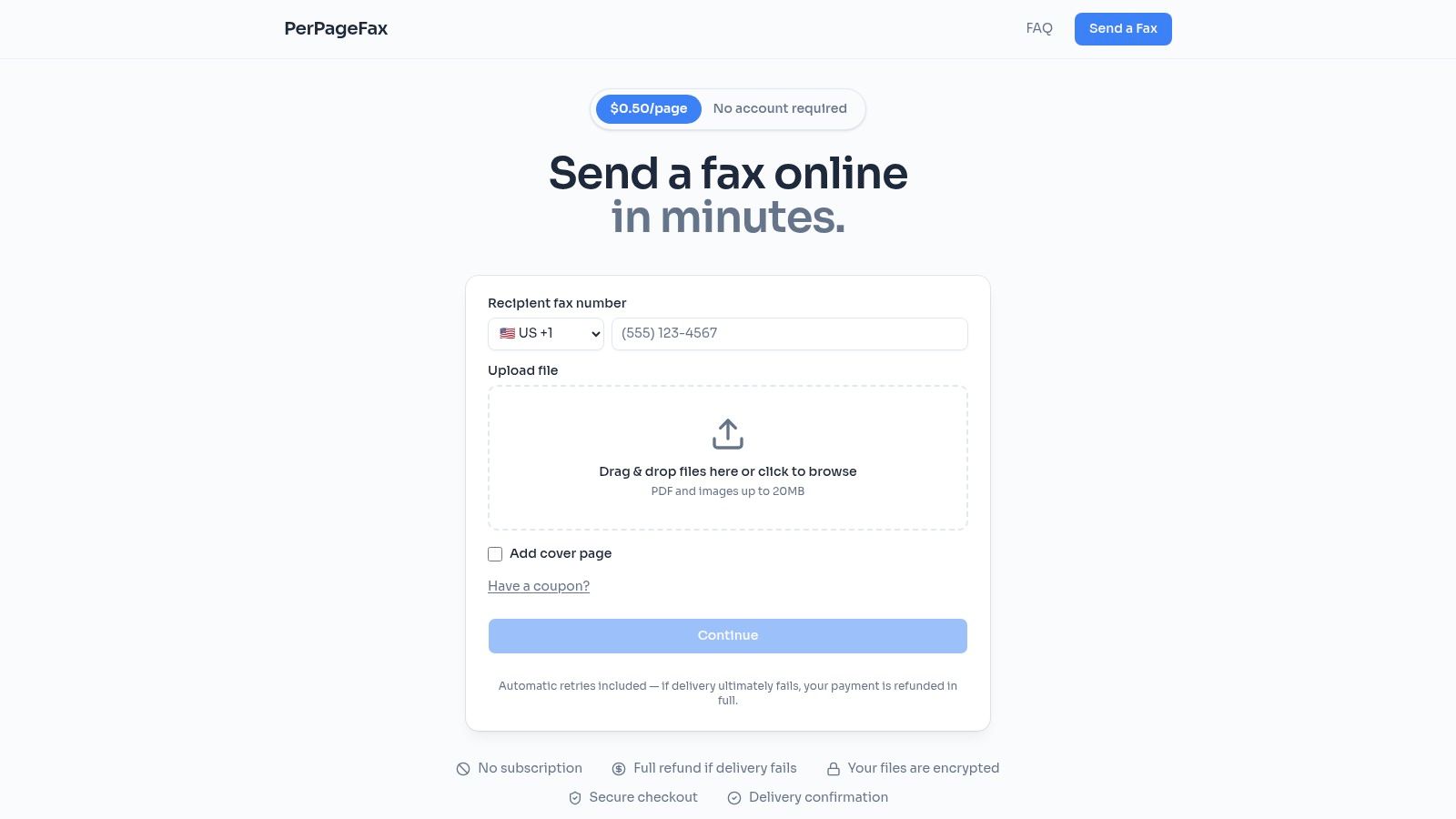
Choose the recipient's country before entering the fax number. The country selector applies the relevant standardized country code, while you still need to enter the recipient's complete fax number accurately. Don't copy a number from an old document without checking it. A single wrong digit can produce a successful transmission to the wrong destination, and faxing generally doesn't provide an undo function.
Add the optional cover page if the recipient needs context or formal metadata. The service places it before the uploaded documents, so count it when you write the total page count on the cover sheet. If the recipient supplied a prescribed cover page, upload that page as part of the document set instead of assuming a generic template will satisfy the rule.
Payment without a recurring account
An accountless, pay-per-page workflow is useful when you need to fax a form once or only occasionally. PerPageFax processes credit or debit card payment through Stripe, uses flat per-page pricing, and doesn't require software installation, a phone line, a trial signup, or a persistent fax number. The service information lists $0.50 USD per page across supported destinations worldwide, so review the destination and final page total at checkout before authorizing payment.
After payment, submit the fax and keep the resulting status URL. A useful guide to sending an online fax can help if you're unfamiliar with the interface, but the browser workflow itself should remain short: upload, address, cover page if needed, pay, send, and verify.
The absence of a phone line doesn't mean the fax is instantaneous or guaranteed. The internet handles your submission, while the service still has to negotiate transmission with the recipient's fax endpoint. That is why the next screen, the live delivery record, matters more than the initial send button.
Verifying Delivery and Handling Retries
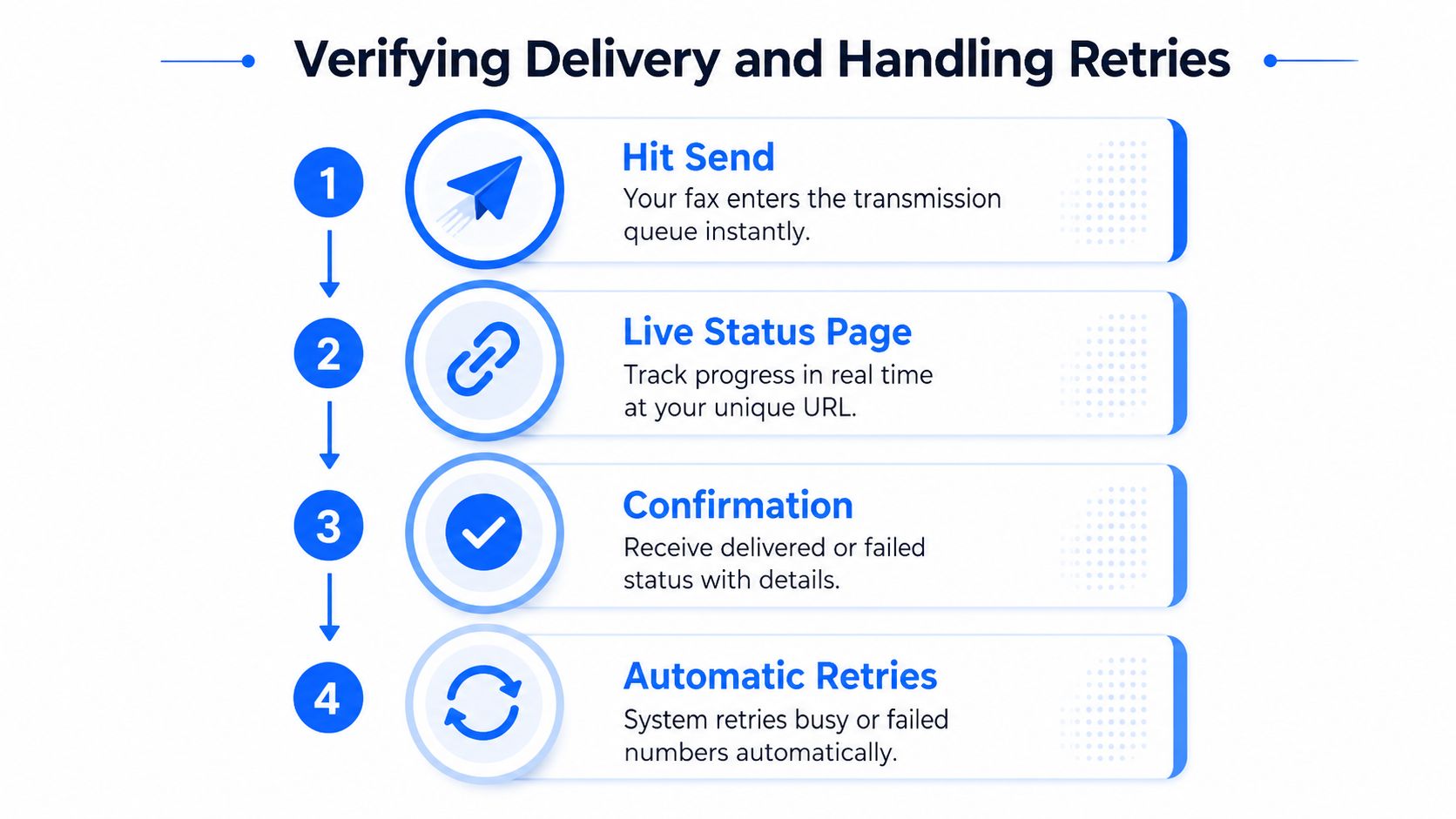
For a high-stakes fax, sent is not the same as accepted. A submission can enter a queue while the destination is busy, unreachable, misconfigured, or unable to complete protocol negotiation. Treat the transmission status as an operational record, not a decorative progress indicator.
PerPageFax provides a unique live status page at a /fax/[id] URL. Open that page after submission and watch for the result showing that the recipient device
reported success. Save the URL or capture the confirmation for your matter file, especially when
the recipient won't provide a separate acknowledgment.
Why retries belong in the workflow
Fax reliability depends on the transport path and the condition of the receiving endpoint. An industry white paper reports that single-page fax-over-IP transmissions can reach about 80% success under normal conditions, while traditional analog faxing has about a 5% failure rate and e-faxing typically falls in the 5% to 8% failure range, as discussed in fax error-rate guidance from InfoTel Systems. The figures vary by deployment, but the practical lesson is consistent: the first attempt isn't the only attempt that matters.
A controlled operational study recorded 84% of transmissions completing on the first attempt, 92% after two attempts, and 94% after three attempts, with an average transmission time of 38 seconds and average total processing time of 70 seconds per unit, according to the fax transmission study proceedings. Those figures support a simple office habit: allow time for retries before a filing deadline, and don't close the browser just because the upload finished.
Practical rule: Keep the status page open until you have a final result, then save the confirmation with the exact document you transmitted.
PerPageFax's automatic retry process attempts failed deliveries without an additional charge for retry attempts. That helps with busy signals and temporary network problems, but retries can't correct a wrong fax number, an unreadable file, or a recipient that no longer accepts fax submissions.
When the status says failed
Check the destination number digit by digit, confirm that the file remains within the service limits, and inspect the document for corruption or unexpected blank pages. If the number and file are correct, contact the recipient through an alternate channel and ask whether its fax line is active, whether a cover sheet is required, and whether the office can confirm receipt after you resend.
Don't rely only on a successful status for legal acceptance. A receiving device can report transmission success while the clerk's office later rejects the filing for missing metadata, an incorrect fee certification, an invalid form, or a deadline problem. The status page proves what the transmission system reported. Keep the recipient's acknowledgment or filing receipt when the matter requires proof of acceptance.
Per-Page Faxing vs Subscription Fax Services
The right pricing model depends on how often you fax, not on how many features appear in a comparison chart. A subscription can make sense for a busy office that sends and receives documents continuously. It can be unnecessary overhead for a taxpayer, freelancer, veteran, or self-represented litigant who needs to transmit a document only when an agency or court specifically requests one.
| Decision point | Per-page service | Subscription service |
|---|---|---|
| Cost structure | Pay a flat fee for the pages you send | Pay a recurring monthly charge |
| Setup | Usually accountless and browser-based | Usually requires account creation and plan selection |
| Best fit | Occasional or one-time transmissions | Frequent business sending and receiving |
| Commitment | No recurring billing or contract | Ongoing billing, with plan terms to review |
| Access model | Use the service when a fax is needed | Keep an account active for continuing access |
| International work | Check the country selector for supported destinations | Compare international coverage and plan restrictions |
An accountless workflow also reduces the amount of personal information stored in a long-lived service account. That doesn't remove the need to protect the document, verify the website, and retain records appropriately. It avoids paying for an account that may sit unused.
What subscription plans can justify
A subscription may provide value when several staff members need shared inbound access, a persistent fax number, recurring notifications, administrative controls, or integrations with business systems. Those features matter when fax is part of daily operations. They matter much less when the task is sending one IRS form or a court notice.
Read the plan terms carefully. Some services place useful features behind trials, account requirements, page allowances, or recurring contracts. A flat per-page option makes the cost easier to connect to the specific transmission, while a subscription charges during idle periods as well as busy ones.
If your fax need arrived as a surprise deadline, don't turn it into a recurring software expense without a clear operational reason.
Real-World Use Cases for Computer Faxing
The IRS permits faxing for targeted submissions, not every filing. The IRS Form SS-4 instructions provide fax numbers for applicants with a U.S. legal residence or principal place of business and a separate number for applicants outside the United States, including U.S. territories and international locations. IRS guidance also says original tax returns generally aren't filed by fax, while designated situations can include EIN requests, powers of attorney, taxpayer authorizations, and certain collection or relief forms, as summarized in IRS faxing guidelines for taxpayer submissions.
Court filings require even more discipline. Washington's cover-sheet requirements illustrate why a generic upload can fail, while Canadian federal rules require fax filings to identify the sender, address, telephone number, transmission date and time, total pages including the cover page, a receiving fax number, and a contact person for transmission problems, as set out in the Canadian Federal Court rules. The Supreme Court of Canada rules also permit filing by fax or email in certain proceedings.
For international contracts, compliance documents, and government correspondence, confirm that the recipient accepts fax and ask whether it requires a particular cover sheet or reference number. Retain the submitted file, status URL, final transmission result, and any acknowledgment together. That small recordkeeping step gives a one-time sender a defensible audit trail without maintaining a fax machine.
PerPageFax provides browser-based outbound faxing with desktop and mobile uploads, international destination selection, optional cover pages, flat per-page pricing, live status tracking, and automatic retries without extra retry charges. Visit PerPageFax when you need to send a verified fax without a phone line, subscription, or installed machine.
Ready to send a fax?
Send your fax online in minutes for $0.50/page — no account needed.
Send a fax now