September 6, 2026
How to Fax via Gmail Without a Fax Machine
Fax via Gmail is a practical way to send documents without a fax machine when you already have the file in your inbox, on your laptop, or in Google Drive. This guide explains how to fax through Gmail, how an email-to-fax gateway works, and what to check before sending so you can improve the chances of successful delivery.
Why Fax via Gmail Matters
Fax has not disappeared simply because most business documents now originate as PDFs, scans, or smartphone images. A 2023 industry survey of U.S. office workers found that 69.0% of respondents used fax for document- and image-based work, while about 90.6% reported using it at least weekly. Many senders also scan the original or start from a digital file, so faxing often begins with a document rather than a standalone machine. The 2023 industry survey
This explains a common operational challenge. A clinic, law office, bank, tax office, or government department may still require fax transmission, while the sender works entirely within Gmail and Google Drive. In that scenario, Gmail serves as the familiar front end, while a separate service converts the email attachment into a fax transmission and routes it to the recipient.
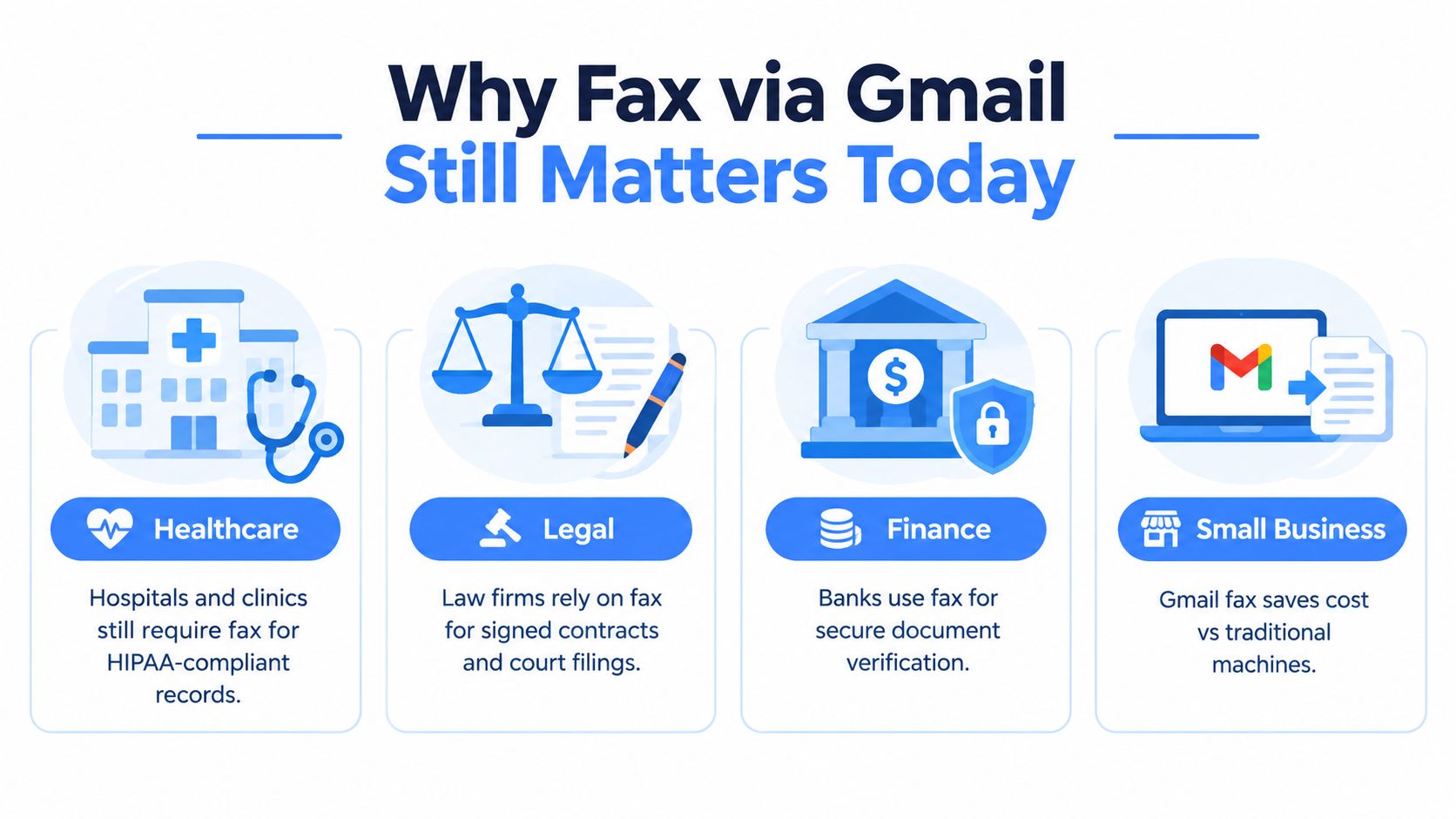
The continued reliance on fax is especially visible in regulated sectors. A 2024 Communications of the ACM report on fax cited estimates that roughly 17 billion fax pages are sent in the United States each year, including more than 9 billion in healthcare. Those figures help explain why an email-to-fax workflow remains relevant, even for users who have never operated a traditional fax machine.
Practical rule: Gmail does not send a fax on its own. It sends an email to a fax gateway, and the gateway handles the conversion and transmission.
Use Gmail when you already have a clean digital document, your fax provider supports email submission, and you want the request preserved within your normal sent-mail record. A physical fax machine may still be appropriate when the recipient requires a specific machine-based workflow, you are starting from paper, or the provider's email method does not offer sufficient delivery detail.
How to Fax via Gmail Works
The process involves four distinct handoffs. Confusing one stage with another is a frequent cause of failed transmissions.
- You compose the message in Gmail. The email includes the destination address supplied by your fax provider and the attached document.
- The fax gateway receives the email. It reads the destination number, extracts the attachment, and converts the file into a fax-compatible format.
- The gateway sends the fax. The document travels through the provider's fax network to the recipient's fax number.
- The recipient device answers. A fax machine or digital fax endpoint receives the pages, after which the provider may issue a success or failure notice.
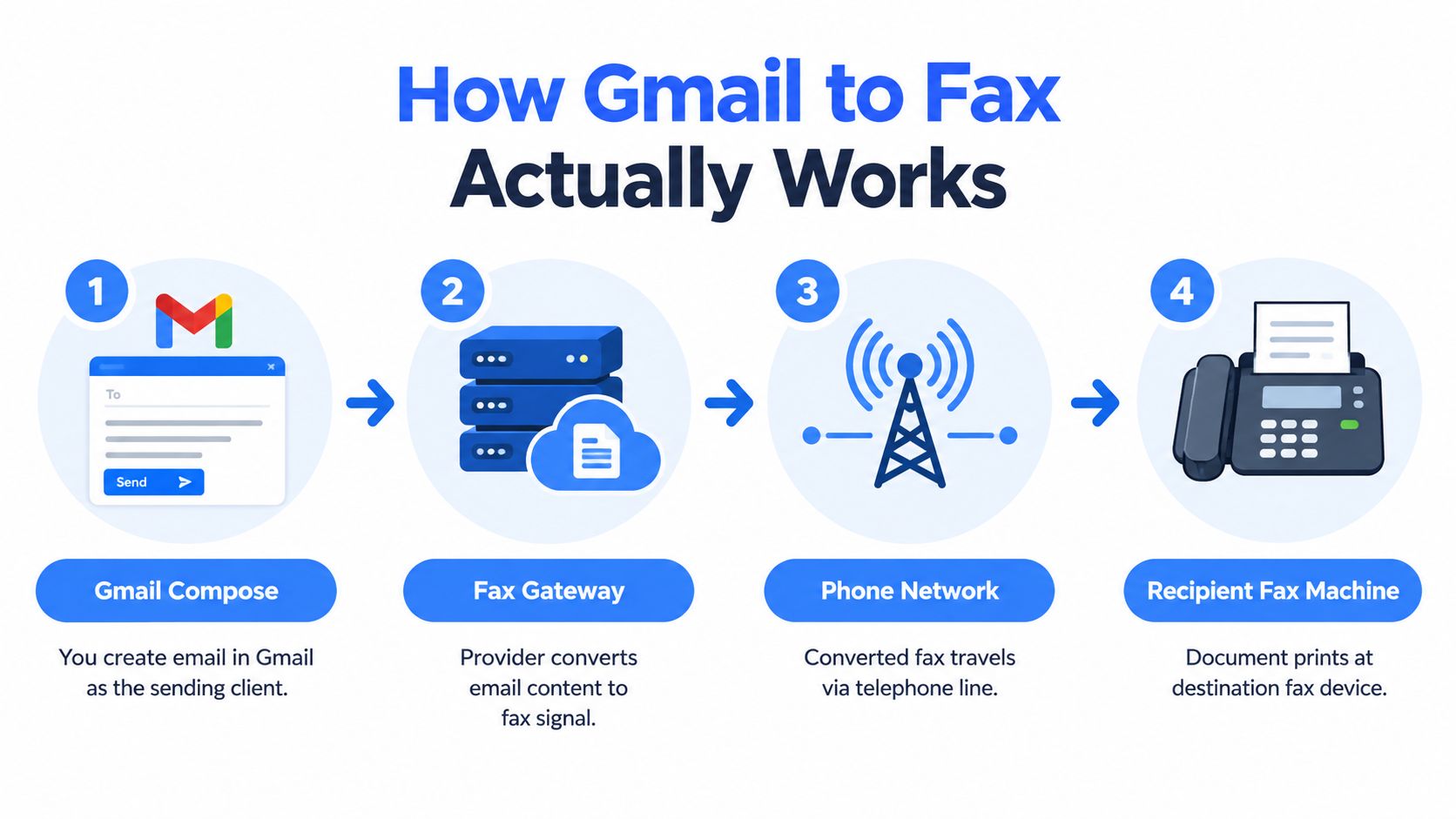
The address typically follows a pattern that combines the fax number with a provider-specific domain. Because formats vary, use the structure provided by the gateway rather than guessing. Gmail is only the sending client. It does not validate the fax number, confirm that the destination accepts fax, or verify that the receiving device printed the pages.
Providers also differ in how they treat attachments and message content. Many services use the email body as cover-page text and the attachment as the fax document, but that behavior should be confirmed before sending any formal or sensitive material. Delivery confirmation varies as well. Some providers return an email confirmation, while others provide a status page or downloadable receipt.
For a deeper explanation of the handoff, see how an online fax service works. If you prefer not to use email at all, a web-based uploader can be simpler. You upload the file, enter the destination number, pay for the transmission, and monitor the result from the provider's interface.
Prepare Documents for Faxing via Gmail
When timing matters, there is rarely room to correct a poor scan after transmission. Fax conversion can soften fine text, reduce color detail, and exaggerate shadows, so document preparation deserves as much attention as the email itself.
Make the file predictable
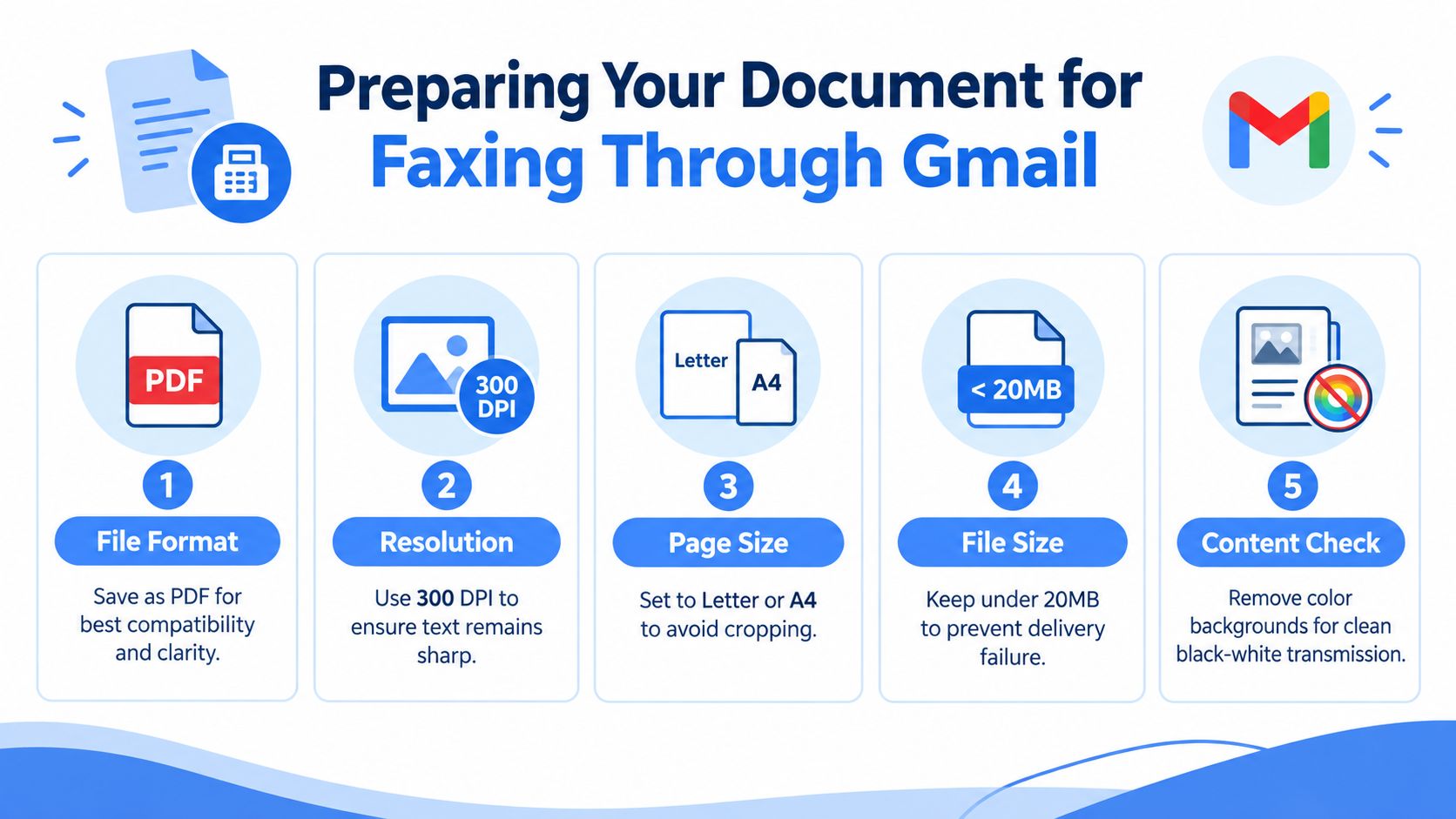
PDF is generally the most reliable format for multi-page business documents because it preserves page order and layout. Gateways may also accept image files, but smartphone photos should be cropped, rotated, and checked for shadows before submission. HEIC images from an iPhone deserve particular attention because some gateways do not accept them. Check the provider's supported file types for online faxing before relying on a phone image.
Run these checks before opening Gmail:
- Review readability: Open every page at normal viewing size and confirm that signatures, dates, account numbers, and small print are legible.
- Set the page layout: Use Letter or A4 sizing to reduce the risk of unexpected cropping when the gateway renders the fax.
- Simplify the design: Remove dark backgrounds, unnecessary color, and decorative elements that can reproduce poorly in black-and-white transmission.
- Check page order: Combine pages into one PDF when possible, then verify that the first page appears first.
- Rename the file clearly: A filename such as
signed-tax-form.pdfis easier to identify than a camera-generated default.
The supplied infographic recommends 300 DPI for sharp text. Resolution alone will not correct an out-of-focus photograph. A clean, evenly lit scan is far more valuable than a large file that preserves background noise.
Control the file size and cover page
Personal Gmail accounts have a 25 MB attachment limit for sending. If the total attachment size exceeds that limit, Gmail replaces the attachment with a Google Drive link instead of sending the file directly, according to Google's Gmail attachment guidance. An email-to-fax gateway typically requires the actual file, not a Drive link.
Many gateways impose stricter limits, often in the 10 to 20 MB range. Compress a large scan or divide a lengthy document before sending, and confirm the provider's limit before a time-sensitive submission. A gateway that cannot retrieve Drive content will not convert that link into fax pages.
Treat the email body as part of the transmission. If the gateway converts it into a cover page, an old signature, forwarded thread, or personal note could be sent to the recipient. Remove unnecessary text, then decide whether a formal cover page is required. Avoid placing sensitive details in the body unless the provider's instructions explicitly require them.
How to Send a Fax via Gmail
Once the document is ready, the Gmail workflow itself is straightforward. The most important work happens in the checks you perform before clicking Send.
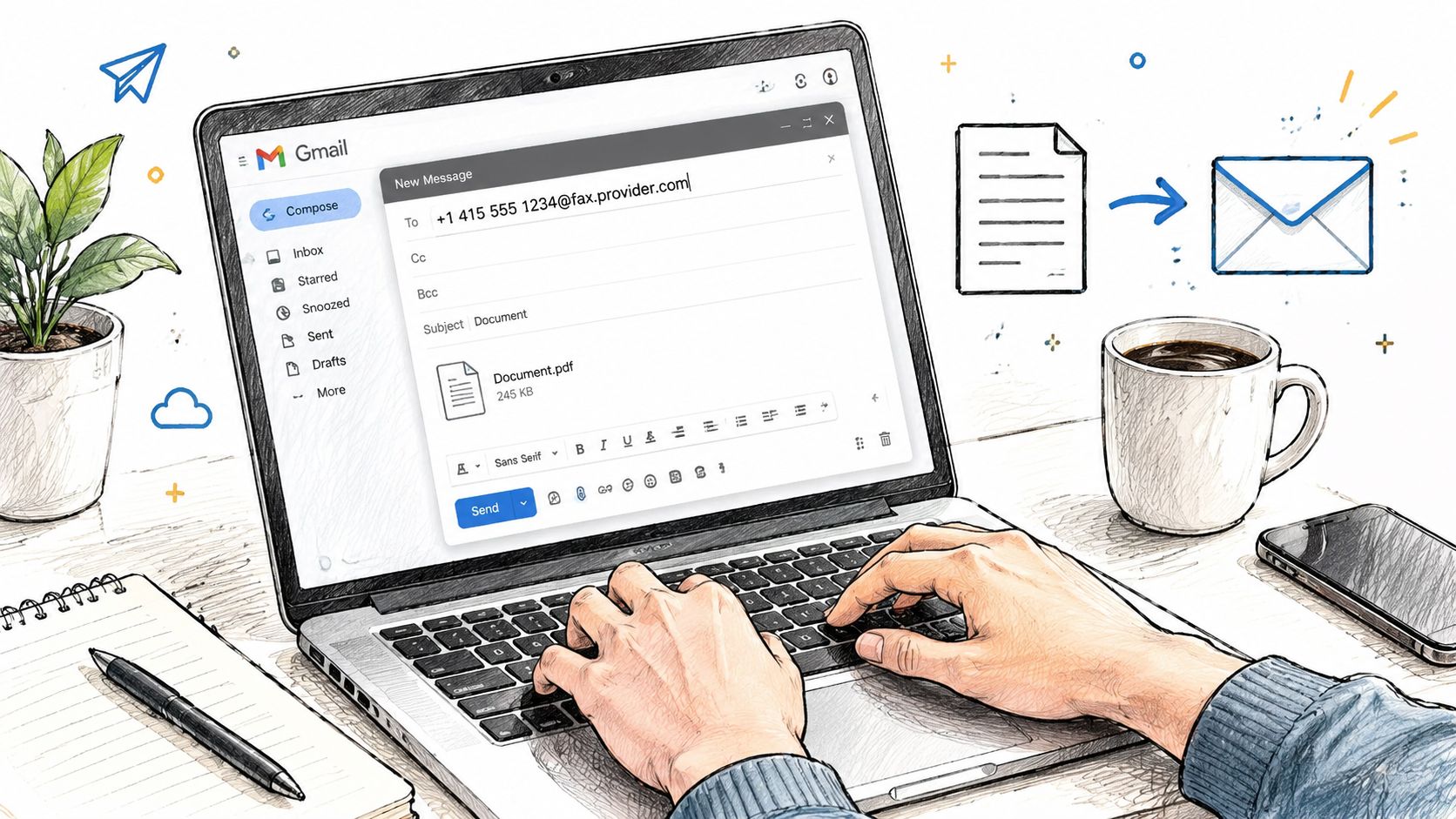
Build the message carefully
Open Gmail and select Compose. In the recipient field, enter the fax-number-plus-domain address provided by your gateway. Do not invent the domain or modify the number format. If the provider requires a country code, include it exactly as instructed.
Add a concise subject line that identifies the transmission. The subject may appear in an email notification or provider record, so make it meaningful, such as the recipient name and document type. Leave the body empty unless you intend the gateway to turn it into a cover page.
Attach the prepared file using Gmail's paperclip icon. After the upload completes, click the attachment name and confirm that Gmail shows it as a true file attachment rather than a Google Drive link. If Gmail has replaced the file with a Drive link, reduce the file size or split the document.
Use a final pre-send check
Before sending, confirm the following:
- Fax number: Compare every digit with the recipient's instructions, including country and area codes.
- Recipient address: Confirm that the gateway domain matches your provider.
- Attachment: Open the file one final time and verify page count, orientation, and legibility.
- Body text: Remove signatures and notes if the gateway uses the body as cover-page content.
- Subject: Identify the document without placing sensitive details in the subject line.
- Timing: Leave enough time for a retry if the recipient's line is busy.
For an unfamiliar destination, a test transmission to a number you control can reveal whether the gateway handles your attachment and cover-page settings as expected. A test does not prove that the final recipient's machine will answer, but it can expose formatting issues before a time-sensitive submission.
After sending, keep the Gmail sent message and monitor the provider's delivery response. Gmail only confirms that it handed the email to the gateway. It does not, by itself, establish that the fax reached the destination device.
Gmail Fax vs Web Upload
Gmail works well when a document is already in your inbox, your organization uses a configured email-to-fax gateway, and sent-mail records are important. It is less practical for a one-time fax, a phone photo, or a transmission that requires clear status visibility without email-formatting variables.
| Feature | Fax via Gmail | PerPageFax Web Upload |
|---|---|---|
| Setup time | Requires a compatible fax gateway and its recipient-address format | Upload directly from a browser without an account |
| Cost structure | Depends on the chosen gateway or fax plan | $0.50 per page across supported destinations, according to the publisher's service information |
| File handling | Gmail personal accounts cap attachments at 25 MB, and gateways may allow less | Accepts PDF, PNG, JPG, HEIC, and TIFF files up to 20 MB and 100 pages |
| International dialing | Depends on the gateway's country support and number format | Country selection and international delivery are built into the web workflow |
| Cover page | Often drawn from the email body, depending on the gateway | Optional cover page before the uploaded document |
| Delivery transparency | Usually an email confirmation, depending on the gateway | Live status page and confirmation when the destination reports success |
| Best fit | Existing Gmail-centered workflows and repeat office processes | One-time, urgent, mobile, or outbound-only faxes |
A browser uploader is especially useful when the source document is a phone photo rather than an email attachment. You can upload the image directly instead of sending it to yourself first, and HEIC support may eliminate a conversion step. The optional cover page also keeps administrative details separate from the main document.
Gmail remains a strong option for organizations that already manage and pay for an email-to-fax gateway. It also keeps the request, attachment, and transmission record together in sent mail. For an urgent one-time fax, compare the gateway's file rules and confirmation process with a browser-based web upload process. Choose the uploader when direct file submission and visible status matter more than keeping the transaction inside Gmail.
How to Confirm Fax Delivery
A fax deadline can still fail even after Gmail shows the message as sent. Wait for the gateway's confirmation, review its status record when available, and save the receipt alongside the exact document that was transmitted. A sent email confirms submission to the gateway, not successful receipt by the destination fax number.
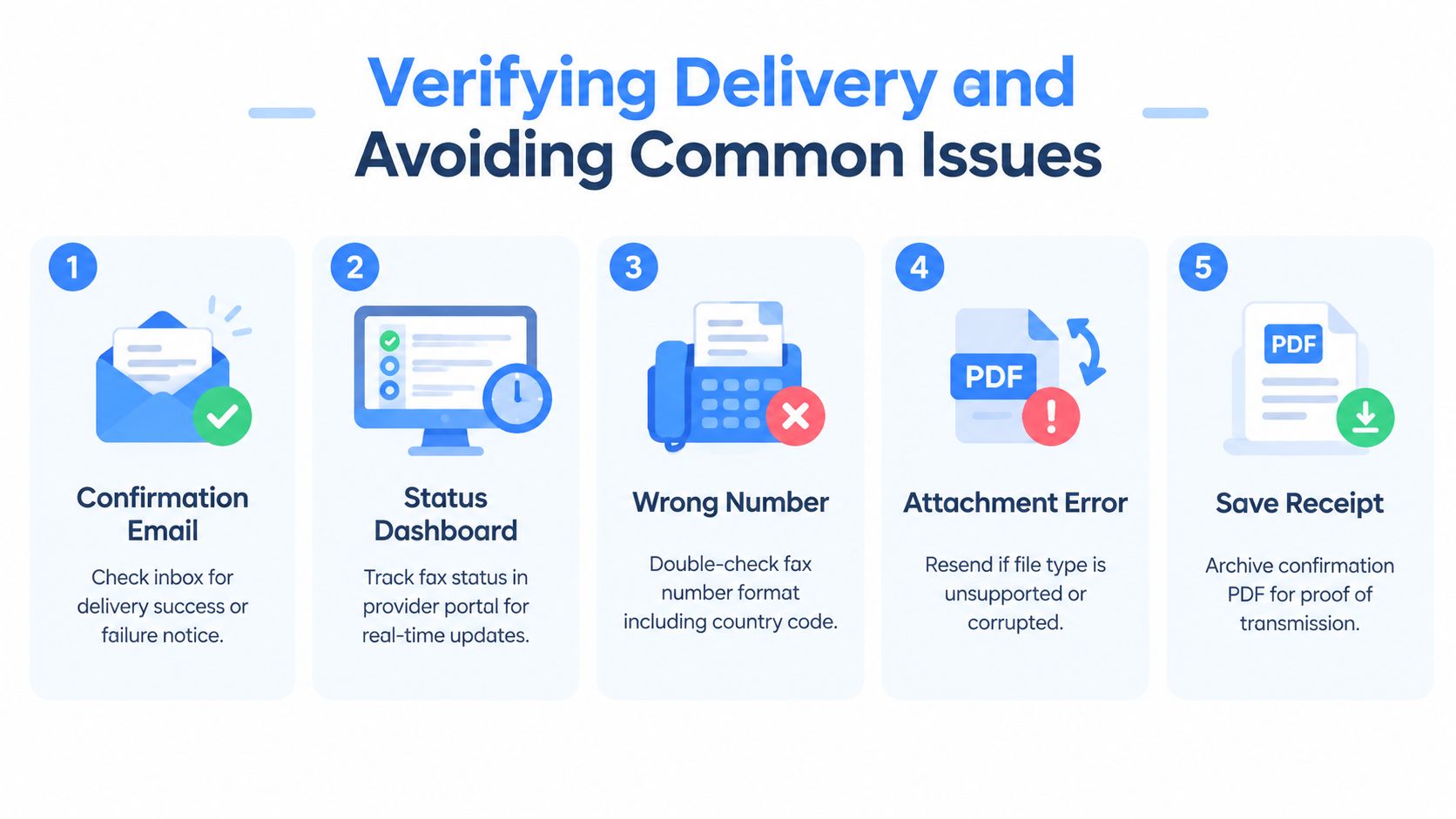
If delivery fails, identify the cause before resending:
- Busy or unreachable line: Verify the fax number, then retry through the provider's workflow.
- Unsupported or corrupted file: Export a clean PDF and attach that version.
- Missing pages: Compare the transmitted file with the original and check the gateway's page limit.
- Illegible output: Rescan with better contrast, remove shadows, and simplify dense page layouts.
- No confirmation: Check spam, the provider dashboard, and the gateway's status page before sending again.
Save the evidence: Keep the confirmation message, status page, timestamp, and exact file that you transmitted.
Privacy deserves separate attention. Fax may lack end-to-end encryption, and email presents its own security limitations. Neither channel guarantees confidentiality by default. Neutral data-protection coverage of fax explains why Gmail-to-fax workflows require additional scrutiny for PHI, legal notices, tax documents, and other regulated material.
Government submissions may also impose rules that a general fax workflow does not address. For Form 8918, the IRS specifies a maximum of 100 pages, lists the electronic fax number 1-844-253-5607, and requires the cover sheet to include the subject, sender information, material advisor name, date, and page count, including the cover sheet. The instructions also warn against placing sensitive information such as an EIN or SSN on the cover sheet. Review the IRS fax instructions before transmitting.
Need a fax cover sheet? Build one free — pick a template, fill in your details, preview it live, and download a print-ready PDF. Build nowFor a one-time fax without a machine or subscription, PerPageFax lets you upload supported files, send internationally, and track delivery from a live status page. Choose it when Gmail's attachment workflow, provider setup, or confirmation process could delay an urgent outbound fax.
Ready to send a fax?
Send your fax online in minutes for $0.50/page — no account needed.
Send a fax now