September 8, 2026
How to Send International Fax Without Mistakes
You've sent the document, watched the fax machine complete its handshake, and saved the confirmation page. Then the recipient abroad says nothing arrived. That situation is frustrating because the transmission can look successful while a hidden dialing rule, office switchboard, or receiving device has stopped the document from reaching the right person.
To send an international fax reliably, you need more than a number that appears complete. You need to verify the exit code, country code, national trunk prefix, PBX behavior, recipient endpoint, and final delivery status. The checks below focus on the failures that ordinary international fax guides often skip.
Why International Faxes Fail When the Number Looks Right
A logistics coordinator in Chicago sends a shipment release to a broker in Hamburg. The number came from the broker's website, the fax machine accepts it, and the confirmation page prints cleanly. Hours later, the broker says the release never arrived.
That failure doesn't necessarily mean the coordinator typed the digits incorrectly. International faxing passes through several layers of numbering rules. The sender's country determines the international exit code, the destination country may use a national trunk prefix, and the recipient's fax line may have its own formatting or routing requirements.
From the United States and Canada, the commonly documented sequence begins with 011, followed by the destination country code and local number. If the destination number includes a domestic leading zero, that zero is typically removed when dialing internationally, as explained in this international fax dialing guide. A number copied exactly from a local directory can therefore become wrong when used from another country.
Practical rule: A fax confirmation tells you what the sending route accepted. It doesn't automatically prove that the intended person has the document in hand.
The receiving side creates another blind spot. Some offices use older fax servers, shared multifunction printers, or lines that answer only during staffed hours. Others route incoming faxes through a PBX that applies its own outside-line prefix. A transmission can reach an institution while still landing in an unattended queue or the wrong department.
If a form appears to have disappeared, the next step isn't always another resend. Start with the recipient's fax number, the confirmation report, and the receiving office's routing process. A practical resource on what to do if a form isn't received can help organize that follow-up.
For every failure pattern in this article, use a verification step before sending. That habit catches invisible formatting errors before they delay a customs release, government submission, legal notice, or time-sensitive business document.
The Anatomy of an International Fax Number
An international fax number has four functional parts: the international access code, the country code, the city or area code, and the subscriber number. From the United States, a fax to
Germany can use 011-49-30-12345678. A fax to Japan
can use 011-81-3-12345678.
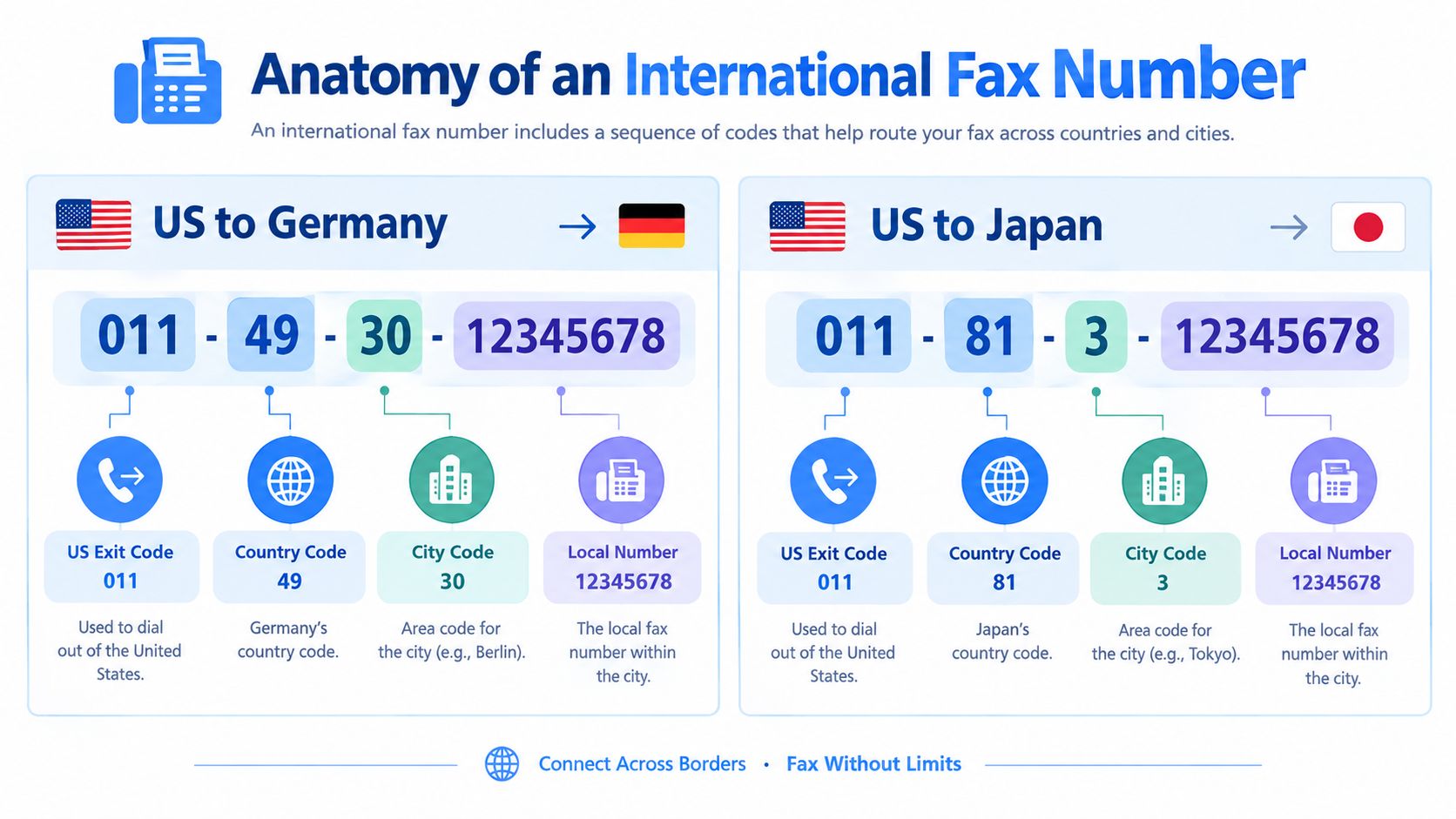
In the German example, 011 is the U.S. exit code, 49 is Germany's country code, 30 is Berlin's city code
after removing the domestic zero, and the remaining digits identify the local fax line. In the
Japanese example, 81 is Japan's country code, 3 represents Tokyo after 03 becomes 3, and the final digits identify
the subscriber.
The country code is the easiest part to check because it identifies the destination country. Common examples include +1 for the United States and Canada, +44 for the U.K., +49 for Germany, +33 for France, +81 for Japan, +61 for Australia, +91 for India, and +55 for Brazil, as listed in this international fax country-code reference.
Where senders usually slip
The first mistake is retaining a domestic trunk prefix. Berlin's local form may begin with 030, while the international form uses 30. Tokyo's 03 becomes 3 after the country code. The
second mistake is assuming every destination uses the same final number length. National numbering
plans vary, so count the complete destination number instead of forcing it into a familiar pattern.
For a quick country-code check, keep this United States international country code guide open while preparing the fax. Online fax platforms often hide the mechanical dialing step, but they still need the correct destination number. You enter the country code and local number, while the service selects the access route based on the sending system's location.
Use the plus-sign format when the platform accepts it, such as +49 30 12345678. Before submitting, compare the number with the recipient's original source and verify
whether its leading zero belongs to the domestic format or the international format.
Three Dialing Traps That Break Cross-Border Faxes
Most failed international faxes fall into three practical categories. The digits may be genuine, but the sequence can still tell the gateway to call the wrong destination.
| Trap | Wrong Syntax (Typical Entry) | Correct International Format | Verification Step |
|---|---|---|---|
| Leading-zero trap | 011-44-020-12345678 | 011-44-20-12345678 | Compare the local number with the destination's international format and remove the national trunk zero when required. |
| Exit-code trap | 011-49-30-12345678 from a non-U.S.
origin | Use the originating country's access code, then 49-30-12345678 | Confirm the sender's exit code before dialing. |
| PBX dial-out trap | 9-011-49-30-12345678 when the
system already adds outside access | The fax system's required external format, entered once | Ask the administrator whether the PBX adds 9, 0, or another
outside-line prefix. |
The leading-zero trap
A sender often pastes 020-12345678 from
a local listing and adds the country code in front. That creates a number with both the international
country code and the domestic trunk prefix. The gateway may reject it, misroute it, or reach a different
service.
Verification: Find the recipient's number in an official international format, then write the domestic and international versions on separate lines. If the destination guide says the zero is a national trunk prefix, remove it only from the international version.
The exit-code trap
The 011 sequence is appropriate
for calls originating in the United States and Canada. It isn't universal. The U.K. commonly
uses 00, Australia uses 0011, and Germany uses 00, so a standalone fax machine
must use the sender's actual originating-country rule. Online services usually normalize this
detail, but a physical machine or office gateway may not.
The PBX dial-out trap
Corporate offices frequently require an outside-line prefix such as 9 or 0. The problem starts when the
user adds that prefix manually even though the PBX or fax server already inserts it. The
system then sends a malformed sequence, often placing the outside-line digit directly before
the country access code.
Verification: Send a test call to the administrator's documented external format, not the number shown on a public website. Confirm whether the fax device, PBX, or carrier owns the responsibility for adding the dial-out prefix.
Sending an International Fax Online Step by Step
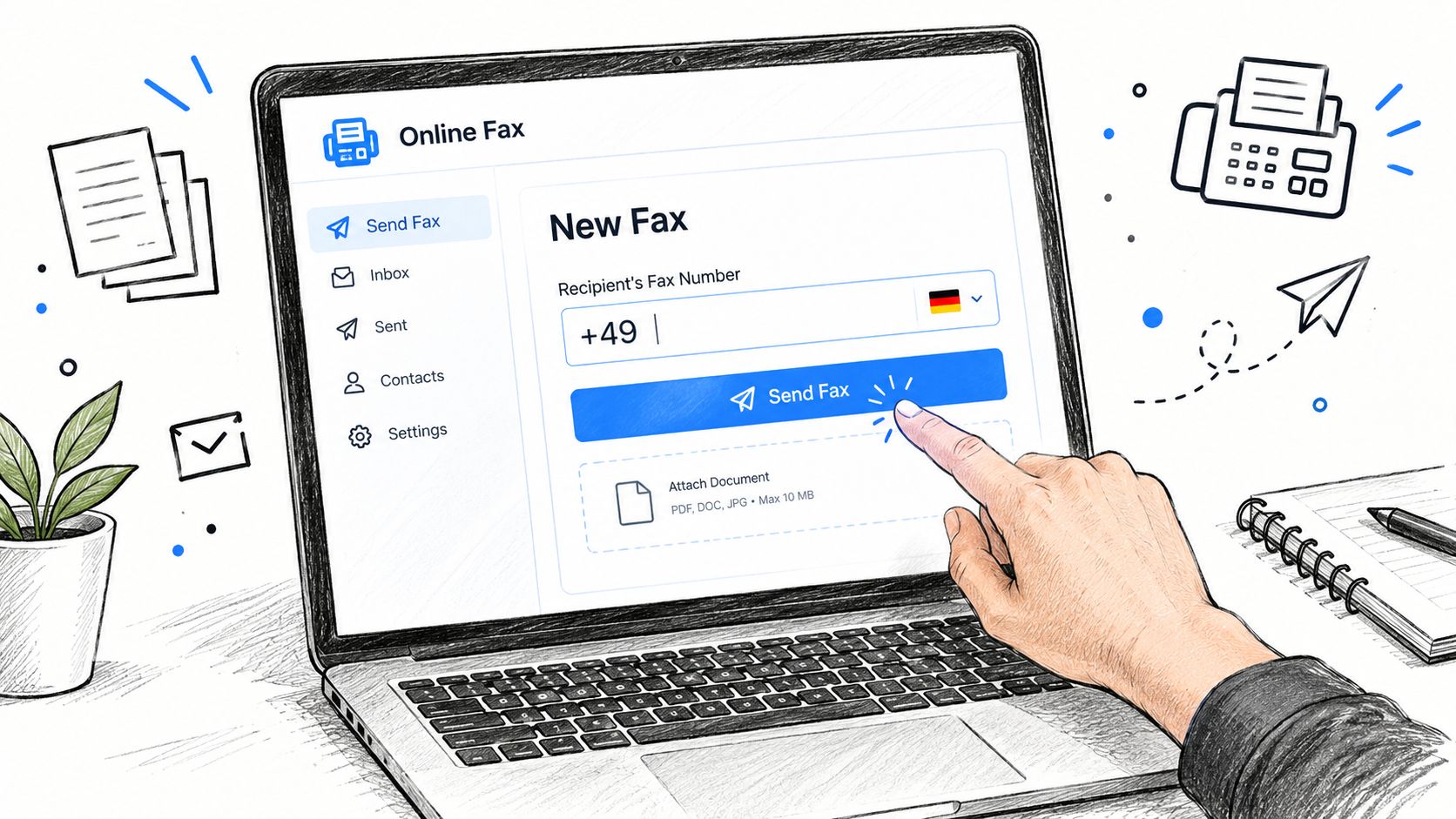
Online faxing removes much of the carrier and PBX complexity, but it doesn't remove the need to prepare the destination correctly. Open the service dashboard and choose a new outbound fax. Don't reply to an old transmission or select a cover-sheet-only mode when the actual document still needs to be attached.
Prepare the number and document
Enter the destination in full international format. Use the plus sign and country code when supported, then enter the local number without a national trunk zero where the destination requires it. A step-by-step guide to sending an online fax can help you check the workflow before submitting a high-stakes document.
Prepare a clean PDF or TIFF. Flatten scanned pages so the receiving system sees the page as a stable image rather than relying on fonts or editable layers that may render differently. Keep the file within the service's stated limits. PerPageFax, for example, accepts PDF, PNG, JPG, HEIC, and TIFF files up to 20 MB total per fax and 100 pages, according to the publisher's service information.
Add a brief cover sheet containing:
- Destination details: State the country, organization, department, and fax number.
- Page information: Include the document page count so the recipient can identify a missing page.
- Sender contact: Add a phone number or email address for delivery questions.
- Routing note: Say that the document is being sent internationally and identify the intended recipient.
The cover sheet gives a shared office a useful routing signal. It won't fix a wrong fax number, but it can prevent a correctly delivered document from sitting in an unmarked queue.
Need a fax cover sheet? Build one free — pick a template, fill in your details, preview it live, and download a print-ready PDF. Build nowReview the number a second time against a country-code list, then submit. Watch the status panel instead of closing the browser immediately.
Do not confuse “queued” with “delivered.” Queued means the service has accepted your request. The useful evidence comes after the transmission reaches the destination route and reports its result.
A typical status sequence moves from queued to sending, then to delivered or failed. Save the confirmation report and the original file together, especially if the fax supports a legal, medical, customs, or government process.
A short visual walkthrough can make the order of these actions easier to follow:
Verifying Delivery When the Recipient Is Abroad
A successful status page proves that the fax route completed its technical exchange with a receiving fax machine or server. It doesn't prove that a person printed the pages, opened the queue, or routed the document to the right employee.
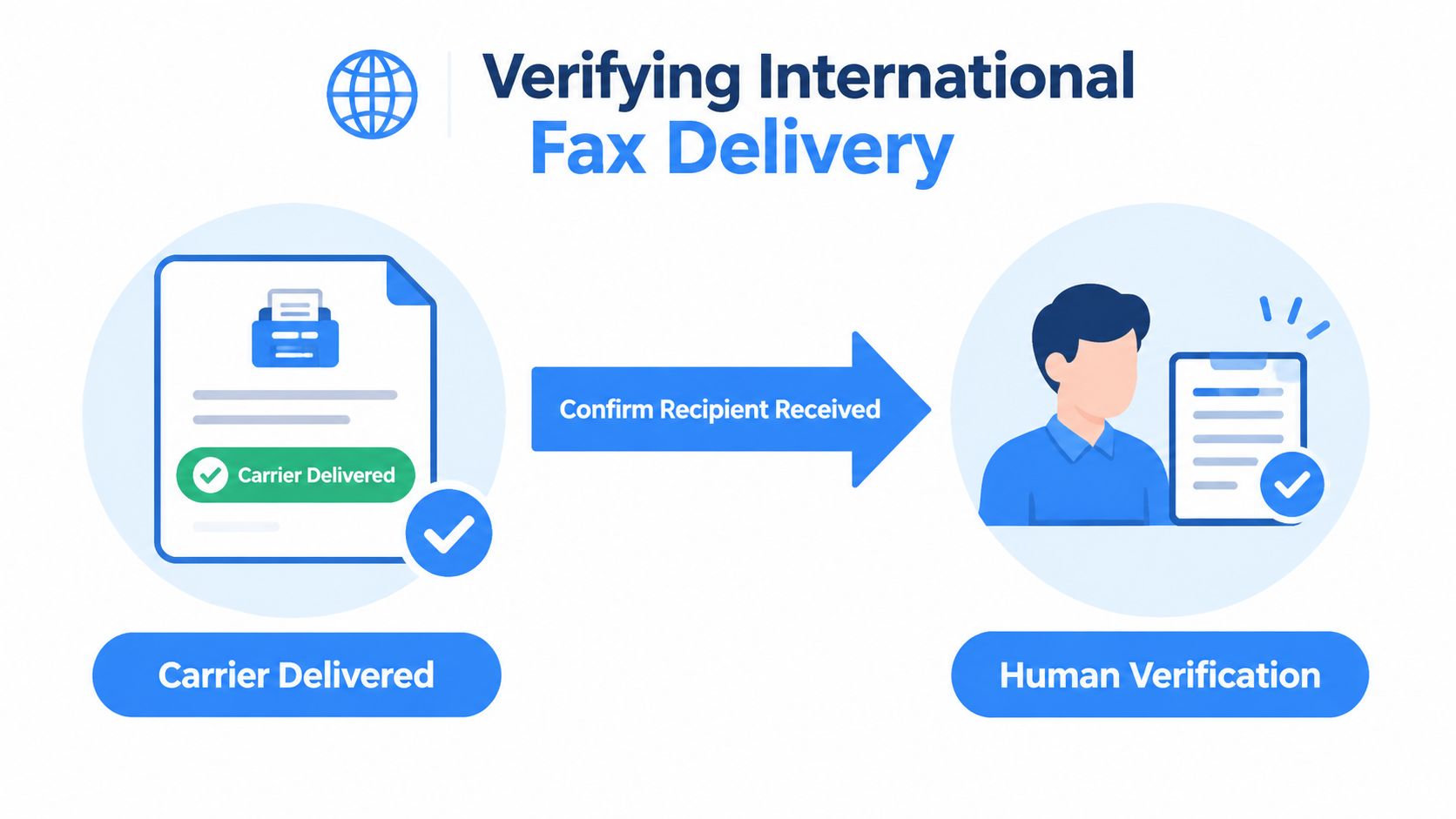
The first layer is the confirmation report. Look for a delivered or success status showing that the receiving endpoint completed the fax handshake and accepted the pages. A failed, busy, or no-answer status after retries points you toward the number, route, schedule, or destination equipment. Don't assume a temporary failure means the entire network is unavailable.
Fax behavior over IP can vary by route and protocol. Modern services may use ECM and T.38 fallback to stabilize transmissions, and one industry report summarizes an average of 1.33 transmission attempts per successful fax, with reported success rates of about 82% for T.38 plus ECM compared with roughly 46% for ECM without T.38 in the cited conditions. Those figures come from an industry reliability summary, not a guarantee for every destination or provider, so retry handling and route quality still matter. See the fax reliability explanation covering ECM and T.38 for the technical context.
The second layer is human confirmation. Call or email the recipient and ask whether the document arrived, particularly when the fax contains a signature, customs instruction, legal filing, or medical record. Cross-border delivery may also encounter time-zone differences and legacy equipment, so allow the service's retry process to run before declaring the attempt unsuccessful.
Keep the timestamped report as your primary transmission evidence and the recipient's reply as secondary confirmation. If the recipient reports non-receipt despite a success status, ask them to check the fax server queue, shared printer tray, and department routing log before sending the entire document again.
Pay-Per-Page Versus Subscription for Occasional Senders
The right pricing model depends on how often you fax, how many destinations you use, and who pays when a retry becomes necessary. A pay-per-page service avoids a recurring commitment, while a subscription can bundle capacity and operational features for regular senders.
Published international fax guides show a wide spread, including $2.99 to 6.99 per fax depending on destination and included pages, while another service advertises $2.75 for a limited-page international fax. These examples come from separate providers, so compare the total transaction cost rather than treating any single advertised price as a market standard. The pay-per-page versus subscription fax comparison provides a useful framework for that decision.
| Factor | Pay-Per-Page | Subscription |
|---|---|---|
| Monthly commitment | No recurring fee in the model described by the provider | Recurring monthly charge |
| Occasional use | Suits sporadic international documents | May cost more during inactive periods |
| Retry economics | Check whether retries create another charge | Some plans include retry handling |
| Volume | Easy to budget per transmission | Better suited to steady sending |
| Route features | Depends on the service | May include larger limits or dedicated routing |
| Record keeping | Save each confirmation to track spend | Review account usage and included pages |
For a one-time or irregular fax, pay-per-page is often easier to justify because you aren't paying for unused capacity. The trade-off is that a failed dial, wrong trunk prefix, or endpoint busy condition may create another bill if the provider charges per attempt or page.
A subscription can make sense for an office that sends regularly across several regions and needs consistent routing, larger file handling, or bundled retries. Before signing up, inspect the plan's international destinations, overage rules, retry policy, cancellation terms, and whether unused pages expire.
Whatever model you choose, send a small test when the recipient permits it, verify the status, and retain the report. That prevents you from paying again for a mistake the carrier has already processed.
Pre-Send Checklist and Final Best Practices
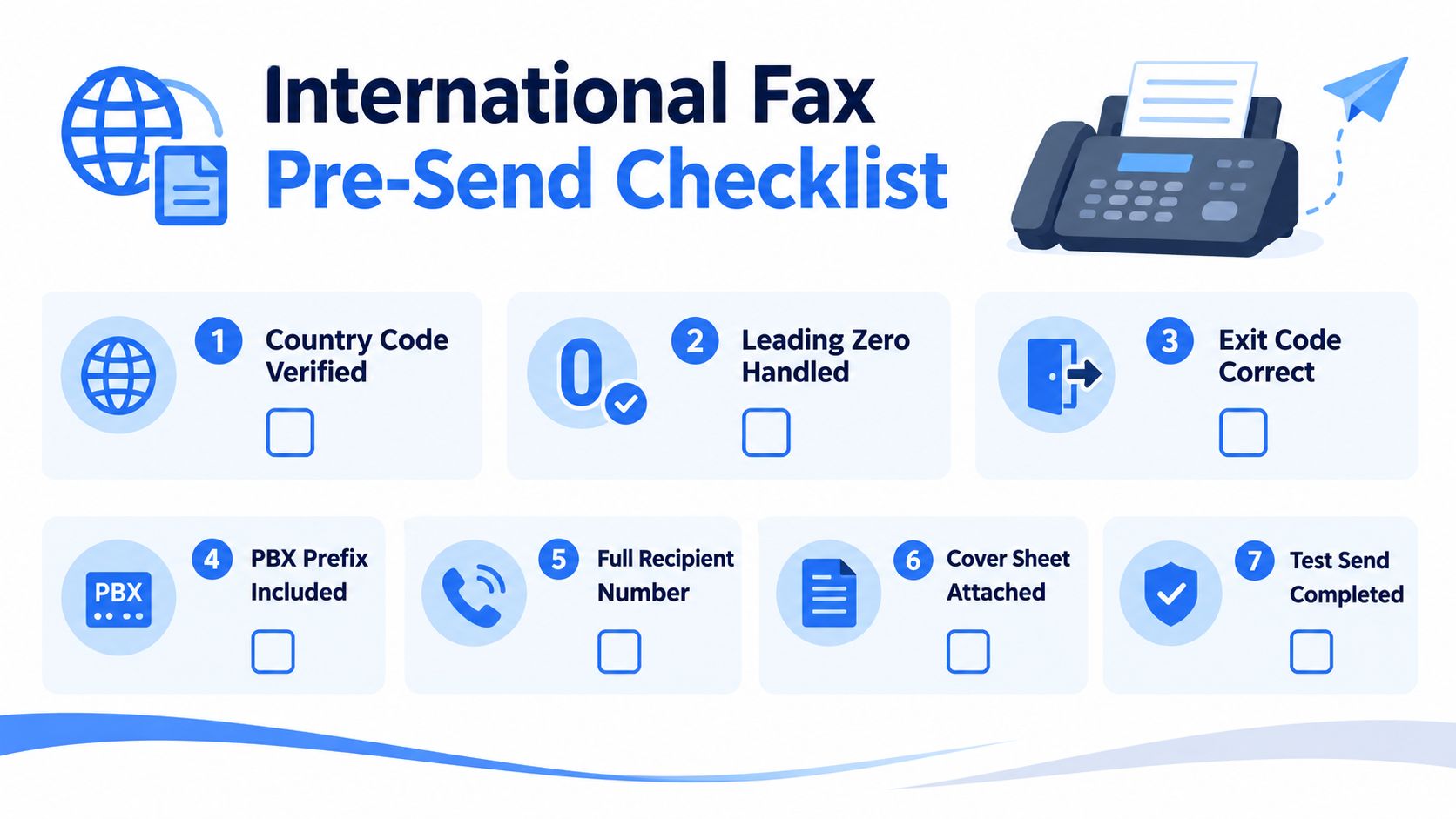
Use this checklist immediately before you submit an international fax:
- Country code verified: Match the destination country and code against a reliable international list.
- Leading zero handled: Remove the domestic trunk zero when the destination's international format requires it.
- Exit code correct: Confirm the access code for the country where the fax originates.
- PBX prefix checked: Determine whether the office
system adds
9,0, or another outside-line digit. - Full recipient number entered: Include the complete city or area code and subscriber number.
- Cover sheet attached: State the destination, recipient, page count, and sender contact details.
- Test send completed: For a new or high-friction destination, send a short test when timing allows.
For consistent formatting, reference ITU-T Recommendation E.123 conventions, confirm the exit code against the originating country, and distinguish a domestic number from its international form. Don't add a leading zero just because it appears on a local website. Don't duplicate a PBX prefix that the office gateway already supplies.
Attach a clear cover sheet, request a delivery receipt, and keep the original PDF or TIFF in your records. For legal or regulatory faxes, retain the confirmation report for at least 30 days. If the document concerns an IRS submission, check the IRS geography-specific fax number and preserve the confirmation, because the IRS publishes separate fax numbers for western states and for filers in APO/FPO locations, U.S. territories, and foreign countries. The IRS fax submission guidance also notes that some forms require a handwritten signature when faxed or mailed.
Each checklist line maps to a real failure pattern. The country code and leading-zero checks address misrouting, the exit-code check addresses origin differences, the PBX check addresses office routing, and the confirmation report addresses the gap between technical delivery and human receipt. Treat every item as a verification step, not clerical overhead.
PerPageFax lets you send outbound international faxes without an account or subscription, using flat $0.50-per-page pricing, supported file uploads, automatic retries without an additional retry charge, and a live status page for each transmission. Visit PerPageFax to check the destination, upload your document, and track the delivery result before you move on to the next deadline.
Ready to send a fax?
Send your fax online in minutes for $0.50/page — no account needed.
Send a fax now