September 12, 2026
Downloadable IRS Fax Confirmation
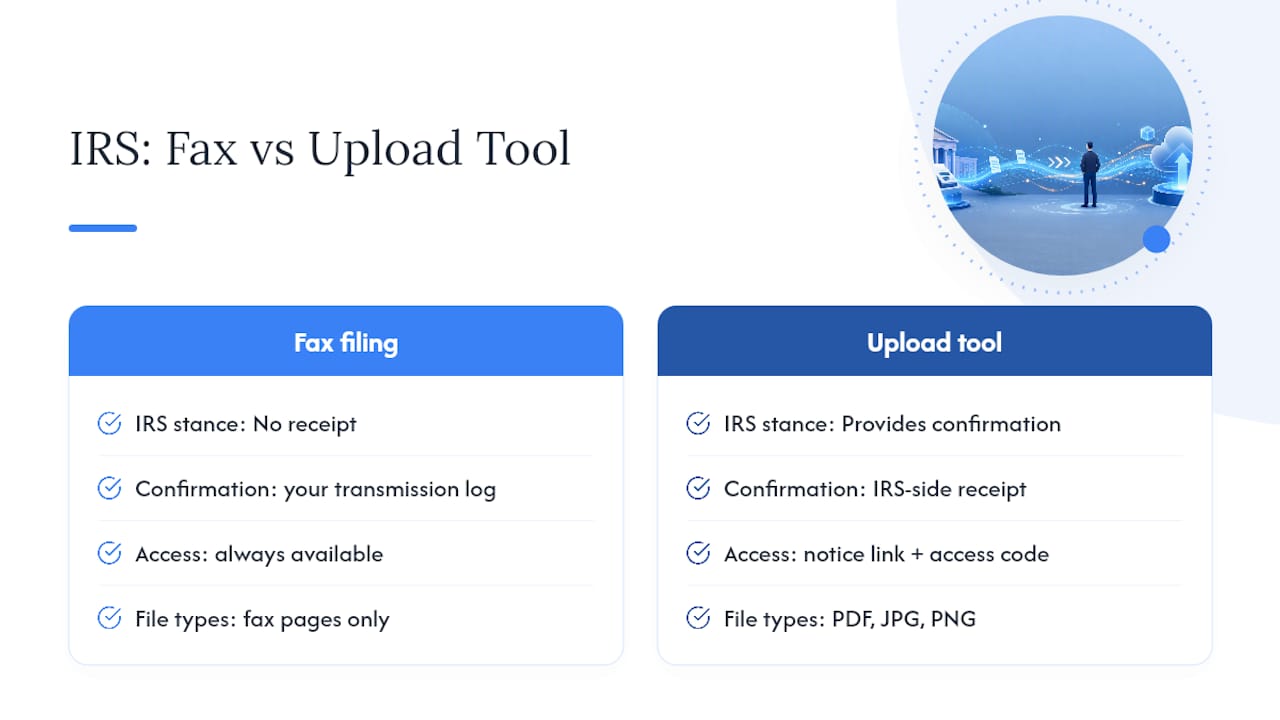
The IRS typically does not send its own fax confirmation or receipt. Your fax transmission log is the proof you actually have, so download it and label it the moment your fax goes through. When a notice includes a Document Upload Tool link, use that instead: it gives you an IRS-side confirmation that your fax alone cannot.
TL;DR:
- The IRS generally does not issue official fax confirmations, making your transmission log or a Document Upload Tool confirmation the primary proof of submission.
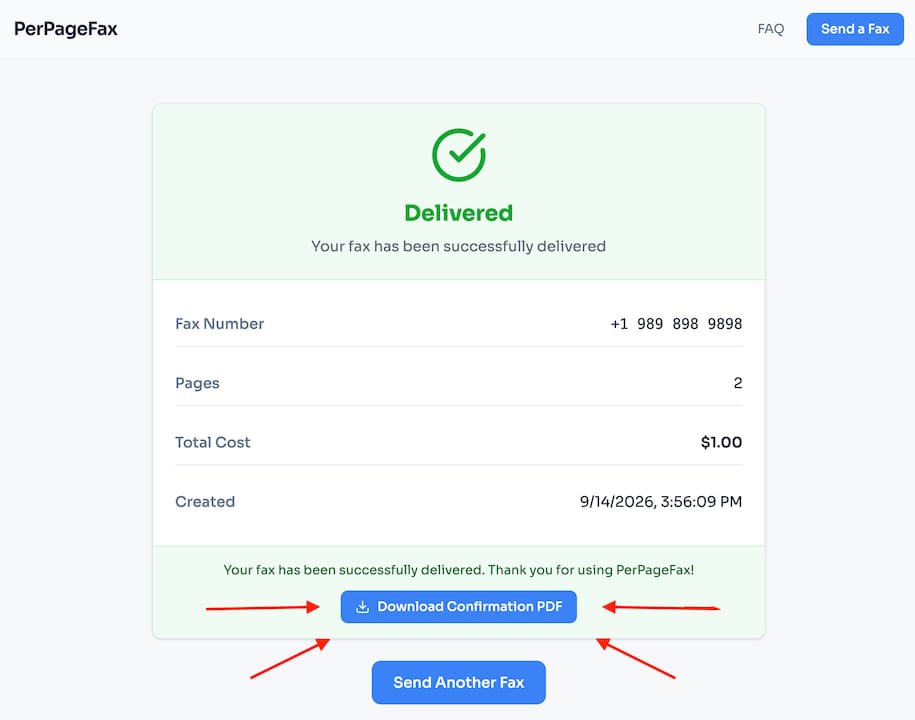
- A valid fax confirmation must include the recipient’s number, a timestamp with time zone, total page count, and a clear delivery status to be considered reliable.
- Using an online fax service that provides automatic, downloadable delivery confirmation offers the strongest proof, especially when the IRS notice includes a Document Upload Tool link.
- For forms subject to temporary fax procedures, follow strict rules on page limits and single-form transmissions, as failure to comply can result in rejection without acknowledgment.
- If the IRS claims it never received your fax, present your transmission details clearly, follow up with written records, and consider escalating to the Taxpayer Advocate Service if necessary.
What Counts as IRS Fax Confirmation Proof
An IRS fax confirmation isn’t a single document. It’s a category, and knowing which artifact you’re holding determines how much weight it carries if the IRS ever questions whether you sent something.
Three types of proof show up most often. A paper machine report prints out of a physical fax machine and shows a status line (usually “OK” or “sent”), the receiving number, and a timestamp. An online delivery confirmation, delivered as a PDF or email from a fax service, documents the same information in a format that doesn’t fade or jam in a drawer. A provider dashboard log tracks every transmission tied to your account, which matters if you send multiple IRS documents across a tax year and need to find one fast.
Whichever format you get, four fields make the difference between a confirmation that holds up and one that doesn’t:
- The full recipient fax number, matched against the IRS notice or form instructions
- A timestamp that includes the time zone, not just a bare date
- The total page count transmitted
- The final delivery status (success, failure, or busy/retry)
Pro Tip: If your only confirmation is thermal paper, scan it within a week. Thermal print fades faster than people expect, sometimes within a year, and an unreadable confirmation is functionally no confirmation at all.
Once you have the file, rename it with the form number and tax year (something like “3115_2025_fax_confirmation.pdf”) and store it in the same folder as the document you faxed. Consistent naming is what lets you find proof of IRS document submission two years later when a notice shows up asking about it.
Where the IRS Says No and Where It Says Yes
The IRS is direct about this on its own guidance pages, and the directness is useful. For faxed duplicate copies filed under certain temporary procedures, the IRS states plainly that it will not issue a receipt.
“No. The IRS will not provide a confirmation or receipt” for faxed duplicate copies submitted under temporary fax procedures for Form 3115.
That single line, repeated across similar newsroom notices, is the reason your own transmission log matters so much. But it’s not the whole picture. The IRS Document Upload Tool works differently: taxpayers upload PDF, JPG, or PNG files through a secure link, and the tool explicitly tells them they will “get confirmation that we received your documents.” That’s an IRS-side confirmation, not a self-generated one, and it closes the gap that faxing leaves open.
The catch is access. The upload tool only works when a specific IRS notice includes its URL and an access code. You can’t use it for every filing, and it functions as a one-way upload channel rather than two-way correspondence with an agent. When it’s available, though, it beats faxing for one simple reason: the confirmation comes from the IRS itself, not from your machine or your fax provider. The agency has said it plans to expand secure digital correspondence to more notices over time, which means upload confirmation may become the standard rather than the exception.
Until that expansion reaches your specific form, here’s the practical rule: check the notice for an upload link first. If there isn’t one, fax and treat your transmission log as the confirmation you’re stuck with.
How to Confirm the IRS Received Your Fax: A Checklist
Follow these steps in order, ideally within minutes of hitting send, not days later when memory has faded and files have scattered.
- Download your fax transmission confirmation immediately. Whether it’s a printed report or a PDF from an online service, capture it before you move to the next task. Confirmations that live only on a machine’s temporary memory can disappear.
- Verify the recipient number against the source document. Cross-check the number you faxed against the one printed on the IRS notice or listed in the form’s official instructions. A single digit error sends your documents nowhere, and you won’t find out until it’s too late to fix quietly.
- Use the Document Upload Tool if the notice offers one. An upload confirmation from the IRS outranks any fax log you generate yourself, since it comes straight from the agency’s system.
- Log any resend as a separate event. If you’re not confident the first transmission went through, resend during off-peak hours (early morning tends to see less line congestion) and save that confirmation under a distinct file name. Never overwrite the original.
- Add a backup method when a deadline is close. Certified mail with a postmark, or an upload through the IRS tool, both create a second layer of proof that doesn’t depend on a fax line staying open.
Pro Tip: Send test pages hours (not minutes) before a deadline. A busy signal at 4:45 PM with a 5:00 PM cutoff leaves you no room to recover.
None of these steps require special equipment. What they require is discipline right after transmission, because that’s the window where confirmations are easiest to lose and hardest to reconstruct later.
What to Do When the IRS Says It Never Got Your Fax
Hearing “we don’t have that on file” from an IRS representative is unsettling, but it’s a solvable problem if you kept your records.
Start by pulling up your transmission confirmation before the call, not during it. Point the representative to the exact recipient number, date, time, and page count. Specific numbers move a conversation faster than a general claim that you sent something.
Deciding whether to resend or mail instead depends on timing. If a deadline has already passed, resending by fax alone doesn’t fix a late filing. Certified mail creates a postmark that can matter more than a fax log at that point, since a fax delivery status doesn’t establish the legal filing date the way a postmark can.
A few habits protect you during escalation:
- Write down the date, time, representative’s name or ID, and what was said on every call.
- Ask explicitly for written acknowledgment of your submission, even if it takes a follow-up letter to get one.
- Keep a running log of every contact attempt, in order, with your original transmission confirmation attached to the file.
- If the IRS still can’t locate your documents after a reasonable follow-up window, contact the Taxpayer Advocate Service, which exists specifically for taxpayers stuck between a filed document and an agency that says it never arrived.
The Taxpayer Advocate Service isn’t a first call. It’s the step you take after documentation and follow-up calls haven’t resolved a receipt dispute on their own.
Fax Limits and Why a Confirmation Isn’t a Postmark
Certain IRS forms carry rules that trip people up because they assume all fax submissions work the same way. They don’t.
Form 3115 and Form 8023 both have temporary fax procedures with specific constraints: send only one form per fax transmission, and stay under a limit of 100 pages or fewer per the Form 8023 fax guidance. Combine two filings into one transmission, or exceed the page cap, and you risk a rejected or partial submission with no clean way to know which pages made it through.
The deeper issue is legal, not procedural. A successful fax delivery status confirms your machine or service transmitted the pages. It does not automatically establish “timely filing” the way a postmark does under 26 USC 7502, the statute that protects mailed documents postmarked by a deadline even if the IRS receives them later. Fax transmission and legal timely filing are related but not identical concepts, and treating them as interchangeable is where taxpayers get into trouble on close deadlines.
Timing habits that reduce risk:
- Fax early in the business day, when lines are less congested.
- Never fax anything due that day during the final hour before a deadline.
- For high-stakes filings, pair your fax with certified mail or an upload confirmation as a second layer of proof.
Perpagefax: Built for the Confirmation You Need
An online fax service closes the exact gap that a walk-up fax machine leaves open: The service generates a downloadable delivery confirmation for every transmission, complete with the recipient number, timestamp, and page count, the same fields the IRS notices point to when they ask you to keep proof of sending. Automatic retries reduce the odds of a failed line attempt going unnoticed, and encryption keeps tax documents secure in transit.
A workflow that works well for IRS filings looks like this:
- Prepare a cover sheet with your name, the form number, and the tax year clearly listed.
- Confirm the recipient fax number against the IRS notice or the form’s own instructions before sending.
- Send the document and wait for the delivery status to resolve.
- Download the confirmation PDF immediately, don’t wait until end of day.
- Archive that PDF alongside the faxed document itself, named by form and tax year.
That last step is the one people skip, and it’s the one that matters most when a notice arrives eighteen months later asking whether you ever filed.
What Actually Prevents Fax Disputes
Most fax disputes with the IRS trace back to one habit gap, not bad luck: people send the fax and never look at the confirmation again. It sits on a machine, in a downloads folder, or nowhere at all, until a notice arrives and there’s nothing to point to.
The fix isn’t complicated. Store the transmission confirmation and a PDF copy of the faxed document together, in one dated file, the same day you send it. Thermal paper confirmations fade within months in some cases, so a digital backup isn’t optional if you want proof that’s still legible when you actually need it. That single habit, treated as non-negotiable rather than optional, resolves more disputes before they start than any amount of arguing with a representative after the fact.
Waiting until there’s a problem to go looking for proof is the wrong order of operations. Build the archive at the moment of sending, when it costs you thirty seconds, not six months later when it costs you a Taxpayer Advocate case.
— Engin
Send Your Next IRS Fax With a Confirmation You Can Actually Keep
This service is built for exactly the moment this article covers: sending something to the IRS and needing proof it went through, without signing up for an account or committing to a subscription you’ll use twice a year. Pricing is flat, so there’s no guessing what a tax filing will cost before you send it.
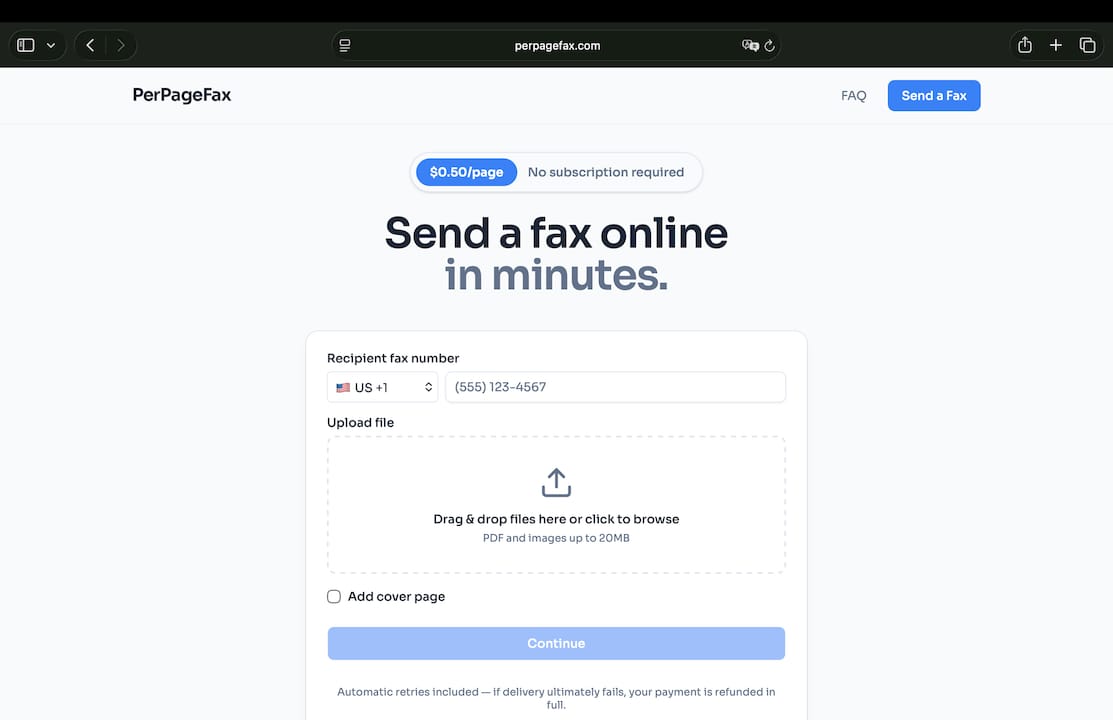
The workflow is straightforward and designed to ensure secure and efficient transmission of your tax documents. First, visit Perpagefax’s dedicated send page, which provides a user-friendly interface for uploading your files. Next, upload your scanned or digital copies of your tax documents, ensuring they are clear and legible. Then, add a cover sheet that includes the specific form number and the relevant tax year to help the IRS identify your submission accurately. Before sending, verify the IRS fax number listed on your notice or correspondence to prevent misdelivery. The system automatically retries if the line is busy, reducing the chance of failed delivery. Once the fax is successfully sent and confirmed, download the confirmation PDF for your records and store it securely alongside your other tax documents. If your files require editing—such as cleaning up scans, converting formats, or merging multiple pages—use the free PDF tools available on the platform to prepare your documents before submission, ensuring they meet the IRS’s requirements for clarity and completeness.
Start your fax now at Perpagefax and keep the confirmation that actually protects you.
Where to Verify Form-Specific Fax Rules
Check the IRS’s own pages before sending anything time-sensitive. The Document Upload Tool page explains upload confirmation eligibility, while newsroom notices for Form 3115 and Form 8023 list current fax numbers, page limits, and confirmation policy for those specific forms.
FAQ
How do I know if the IRS received my faxed documents?
You generally cannot get an IRS-issued fax confirmation for most temporary fax procedures. Your own transmission log, or a Document Upload Tool confirmation when a notice offers that link, is the proof to keep.
How long does it take the IRS to receive a fax?
A fax transmits in the time it takes the pages to send, typically seconds to a few minutes, but the IRS does not disclose a specific timeframe for processing or logging faxed documents once received.
Does the IRS accept faxed tax returns?
The IRS accepts faxed documents for specific forms and temporary procedures, such as Form 3115 and Form 8023, each with its own rules on page limits and one-form-per-fax requirements, but full original tax returns are not generally filed by fax.
How do I find an IRS confirmation letter?
If you’re looking for written acknowledgment of a filing, request it directly from the IRS representative during a follow-up call, since the agency does not automatically mail a confirmation letter for most faxed submissions. Keeping your own transmission log or upload confirmation from services like Perpagefax is a more reliable, resident-side path to proof of sending.
Recommended
Ready to send a fax?
Send your fax online in minutes for $0.50/page — no account needed.
Send a fax now