September 11, 2026
Pay As You Go Online Fax: Practical Guide
You've got a signed tax form, a deadline approaching, and no fax machine nearby. The office printer can scan the document, but email isn't accepted, the local print shop is closing, and a monthly fax plan feels excessive for a single transmission. In that moment, an online fax service pay as you go model can be a practical answer: upload the file, enter the destination, pay for the pages you send, and save the delivery record.
Fax hasn't disappeared just because email is easier. A 2025 Japanese domestic fax usage survey found that 37.9% of workers still use fax in business settings, although that figure was down from 49.7% in 2020 and 2.2 percentage points lower than in 2023 (Japanese domestic fax usage survey). The same survey found that fax use from computers, tablets, and smartphones increased from 7.4% to 11.9%, pointing toward digital fax workflows that no longer depend on a physical machine.
Why Pay As You Go Fax Exists
The need often appears without warning. A freelancer may finish a signed IRS form late in the afternoon, discover that the recipient requires fax delivery, and have only a short window left before the filing deadline. Buying hardware, finding toner, connecting a phone line, or signing a long-term service contract doesn't fit that situation.
Traditional fax equipment creates an ongoing obligation for an occasional task. Someone has to maintain the machine, keep paper available, replace consumables, and deal with busy signals or failed transmissions. A subscription online fax service removes the hardware, but it may still charge a recurring fee during months when the user sends nothing.
That's the gap pay-as-you-go online faxing fills. The sender pays for the pages transmitted instead of paying for a standing bundle of pages, a permanent fax number, or unused monthly capacity. The model suits a person who might fax a tax form, legal notice, insurance document, or overseas purchase order only occasionally.
Practical rule: Choose the pricing model around your real sending pattern, not around the features you might use someday.
Why occasional senders value predictability
A subscription can make sense for a business that sends faxes every week. It becomes harder to justify when faxing happens only a handful of times each year. Unused allowances may expire, and the account can continue renewing even when the underlying need has vanished.
Pay-per-page billing gives the occasional sender a clearer decision. Before pressing send, the user can review the document, see how many pages will be counted, check the destination, and understand the expected charge. That visibility matters when the fax supports a deadline, a legal record, or a compliance process.
Online faxing also has a longer history than many people assume. Internet faxing emerged in 1996, while the earlier Group 3 fax standard in 1983 reduced single-page transmission time from over a minute to under 10 seconds, according to the history and market overview of online faxing. Modern services build on that shift by handling transmission through software and internet-connected infrastructure rather than requiring a dedicated machine.
This guide focuses on the details that matter in a one-off transmission: how the price is calculated, what confirmation really proves, how international numbers work, and when a subscription may still be the better choice. For a technical overview of the workflow, see how an online fax service works in 2026.
How Pay Per Page Fax Pricing Really Works
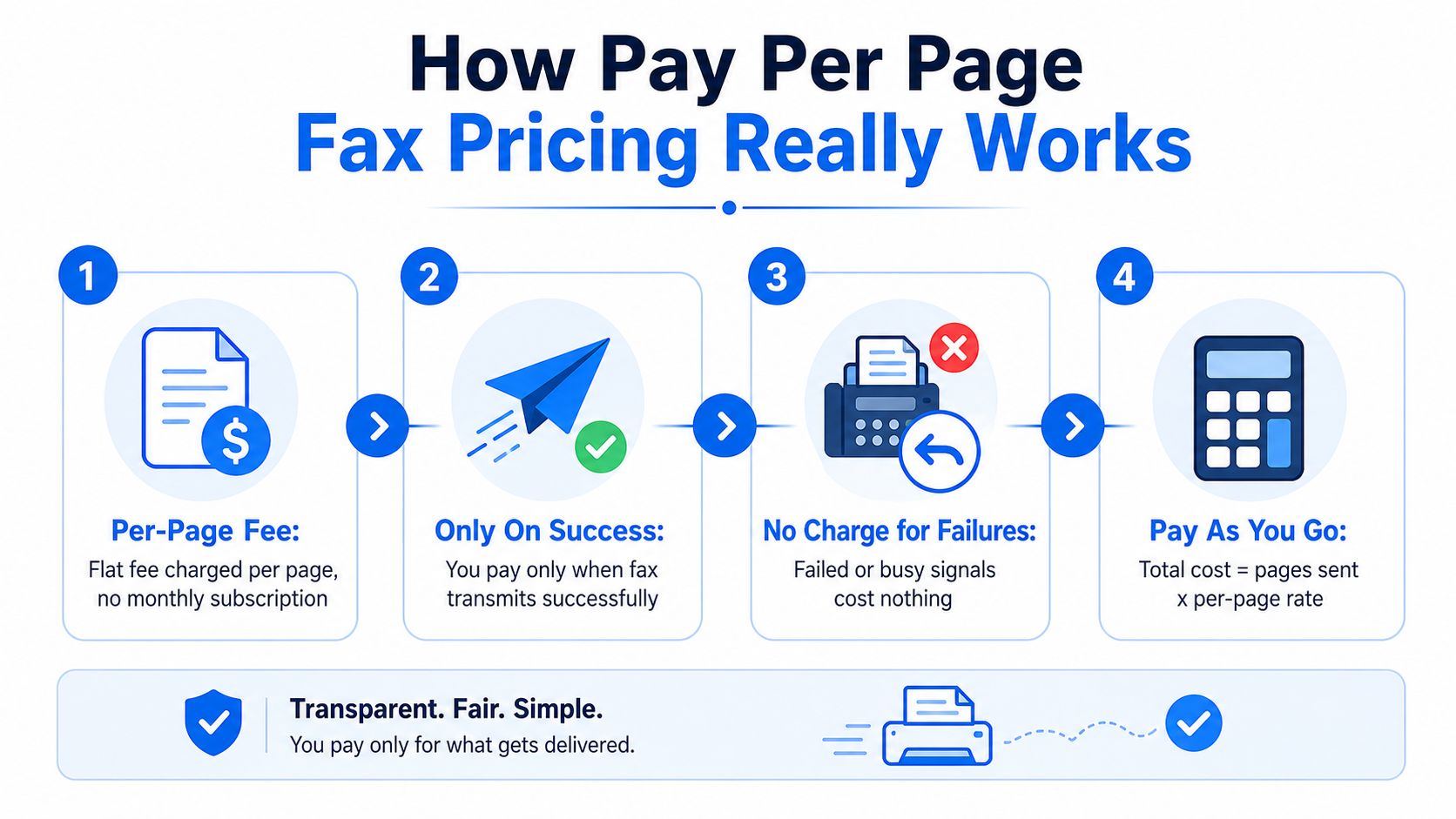
The simplest way to understand pay-per-page faxing is to treat each page as a separate unit of delivery. You upload a document, the service counts its pages, applies the rate for the selected destination, and shows the total before you authorize payment.
A typical calculation looks like this:
- Count the pages. A three-page document creates three billable page units unless the provider has a different cover-page rule.
- Identify the destination. Domestic and international routes may have different rates.
- Check the cover page. Some services include it, while others count it as an additional page.
- Review the total. You should see the charge before transmission begins.
A simple cost comparison
Suppose you're sending a three-page domestic fax. The total follows the domestic per-page rate multiplied by three, with any applicable cover-page treatment made clear at checkout. An eight-page international contract follows the same basic logic, but the international destination may carry a higher per-page rate.
The important point isn't a particular provider's price. It's that the bill grows with the document you send, rather than with a monthly plan you may not use. A short document stays a short transaction, while a longer document produces a larger, visible total.
Pay-as-you-go sending generally means there's no monthly subscription, no minimum commitment, and no renewal to cancel. That makes it different from a subscription plan with included pages, rollover rules, or overage charges. The same principle appears in other prepaid services, so readers comparing flexible payment models may also find this BubblyPhone prepaid calling guide useful for understanding usage-based billing.
Before payment: Confirm the page count, destination country, cover-page treatment, and what happens if the transmission fails.
A failed or busy transmission shouldn't be treated as a successful delivery. The service's terms should explain whether failed attempts are charged, whether retries happen automatically, and whether an unsuccessful fax is refunded. A transparent provider makes those details visible before the sender commits.
The defining feature of this model is cost visibility tied directly to pages sent. You're not buying a recurring service first and hoping the included allowance matches your needs. You're paying for a specific transmission with a specific document and destination.
For another explanation of one-off sending choices, read how to send a fax online without an account.
Pay Per Page Versus Subscription Fax Services
Neither pricing model is automatically cheaper. The right choice depends on how often you send, whether you receive faxes, and whether a recurring fax number or team workflow matters to you.
| Dimension | Subscription Fax | Pay As You Go Fax |
|---|---|---|
| Monthly fees | Recurring charge, even in a quiet month | No recurring sending fee |
| Included pages | Usually includes a monthly allowance | Charges according to pages sent |
| Overage rates | May apply after the allowance is used | No subscription allowance to exceed |
| Commitment length | May renew until canceled | No ongoing renewal for occasional sending |
| Break-even point | Becomes more attractive as sending becomes regular | Becomes more attractive when sending is irregular |
| Ideal user | A team faxing weekly or daily | A freelancer, taxpayer, or small business sending occasionally |
| Risk of overpaying | Paying for unused pages or inactive months | Paying more per page at high volume |
| Receiving faxes | Often available with a dedicated number | May focus on outbound sending only |
When a subscription earns its place
A subscription has a natural advantage when faxing is part of a routine process. A medical office, legal department, or operations team may need a persistent number, shared access, incoming faxes, saved contacts, and predictable monthly administration. Paying a recurring fee can be reasonable when those capabilities support continuous work.
The subscription also becomes easier to justify when the user consistently consumes the included allowance. The key is consistency. A plan that fits a busy month may be wasteful during several quiet months if pages expire or the account keeps renewing.
When per-page billing is safer
Pay-as-you-go faxing is designed for the opposite pattern. You might send one document today, nothing next month, and another document later in the year. There's no unused bundle sitting in the account, and there's no cancellation task after the deadline passes.
Cost test: Compare the subscription's full recurring cost with the pages you genuinely expect to send, including any months when you'll send nothing.
International routing can complicate either model because providers may apply destination-specific pricing or exclude certain countries from a plan. If overseas sending is rare, per-page billing lets you evaluate each transmission separately. If international faxing is frequent, a subscription with suitable coverage may produce a better overall fit.
The decision also depends on what “value” means for the document. A low monthly fee isn't useful if the account lacks clear delivery records, retry handling, or the destination coverage you need. For an occasional sender, proof of successful delivery may matter more than a lower theoretical page rate.
Core Features of a Pay As You Go Online Fax Service
A one-off fax workflow should remove decisions, not add them. The sender needs to upload the right file, identify the destination correctly, approve the cost, and obtain evidence that the recipient device acknowledged the transmission.
Upload and preview
The process usually begins with a PDF, Word file, or image. Automatic page detection helps establish the cost before payment, while a preview gives the sender a chance to catch a missing signature, sideways scan, blank page, or unreadable image.
File handling matters more than it first appears. Someone taking a document photo on an iPhone may have a HEIC image, while an office scanner may produce a PDF or TIFF. Before starting, check the provider's supported file types for online faxing. If you also need a place to store or share the original document, a guide on how to choose a file host can help you separate document storage from fax transmission.
Destination and cover information
A cover page can identify the recipient, company, sender, and subject. That context helps an office route the document after the fax arrives, especially when the destination number serves a large organization.
International sending requires careful number formatting. The number generally begins with a plus sign, followed by the country code and local number. The international fax formatting guide gives examples such as +44 for the United Kingdom and +49 for Germany, and notes that the leading local area-code zero is typically removed when converting to international format, except in Italy.
Country codes are part of the ITU E.164 numbering system and use unique one- to three-digit codes for countries and territories, as explained in this fax country code reference. A country selector reduces the chance that a sender will manually combine incompatible dialing conventions.
Tracking and confirmation
A status page or email may show that a fax was submitted, queued, transmitting, or completed. Those stages aren't interchangeable. A technically meaningful delivery confirmation requires the recipient device to acknowledge receipt, and a useful transmission report typically records the destination number, exact timestamp, page count, and final outcome (fax tracking and delivery confirmation guidance).
Cloud store-and-forward systems can queue transmissions, retry failed attempts, and complete delivery asynchronously. One industry comparison reports success rates of about 96% or higher for cloud fax, compared with roughly 80% for legacy approaches and 85% to 92% for intermediate FoIP variants, while noting that cloud delivery may take seconds to minutes rather than occurring instantly (cloud fax reliability comparison).
That delay can be acceptable if the sender receives a reliable final record. Save the status page, transmission report, or confirmation email with the document so the evidence remains available if the recipient later says the fax wasn't received.
A retry option is especially useful when an institutional line is busy. The sender shouldn't have to start from scratch or pay a second time just because the receiving machine didn't answer on the first attempt. Before sending a sensitive document, verify how the service handles retries, failed transmissions, and stored records.
Real Situations Where Pay As You Go Fax Makes Sense
The usefulness of per-page faxing becomes clearer when the document is urgent but the need isn't recurring.
A freelancer facing an IRS deadline
A freelancer scans a signed tax form into a PDF and sends it to the required IRS fax number from a laptop. The document may be short, but the sender needs more than a screen message saying “submitted.”
IRS instructions for certain faxed submissions cap a transmission at 100 pages and require one form per fax, with the cover sheet included in the page count (IRS fax submission guidance). The sender should therefore check the final page count, avoid combining unrelated forms, and keep the confirmation showing the destination, time, pages, and final result.
A small business sending a legal notice
A business owner uploads a notice to opposing counsel, adds a cover page naming the recipient and subject, and checks the destination number before sending. The document might be only a few pages, but timestamped proof of delivery can be more important than access to a large monthly allowance.
For legal workflows, the sender should save the original file, the final transmission record, and any applicable filing instructions together. Teams managing larger discovery collections can also review resources on streamlining PI discovery management, while treating the fax receipt as a separate delivery artifact.
An operations coordinator contacting an overseas supplier
An operations coordinator sends a purchase order to a supplier in another country rather than waiting for courier delivery. The coordinator selects the destination country, enters the number in international format, previews the pages, and watches the status until the recipient device acknowledges receipt.
The transaction is occasional, so a subscription may add little value. What matters is that the coordinator can confirm the correct destination, see whether the fax completed, and preserve the record alongside the purchase order. If the line is busy, automatic retries can reduce the need for repeated manual attempts.
These examples share a pattern. The users aren't building a permanent fax department. They're solving a specific delivery problem where the recipient still uses fax and the sender needs a record that the document reached the intended machine.
Addressing Common Doubts About Online Pay Per Page Fax
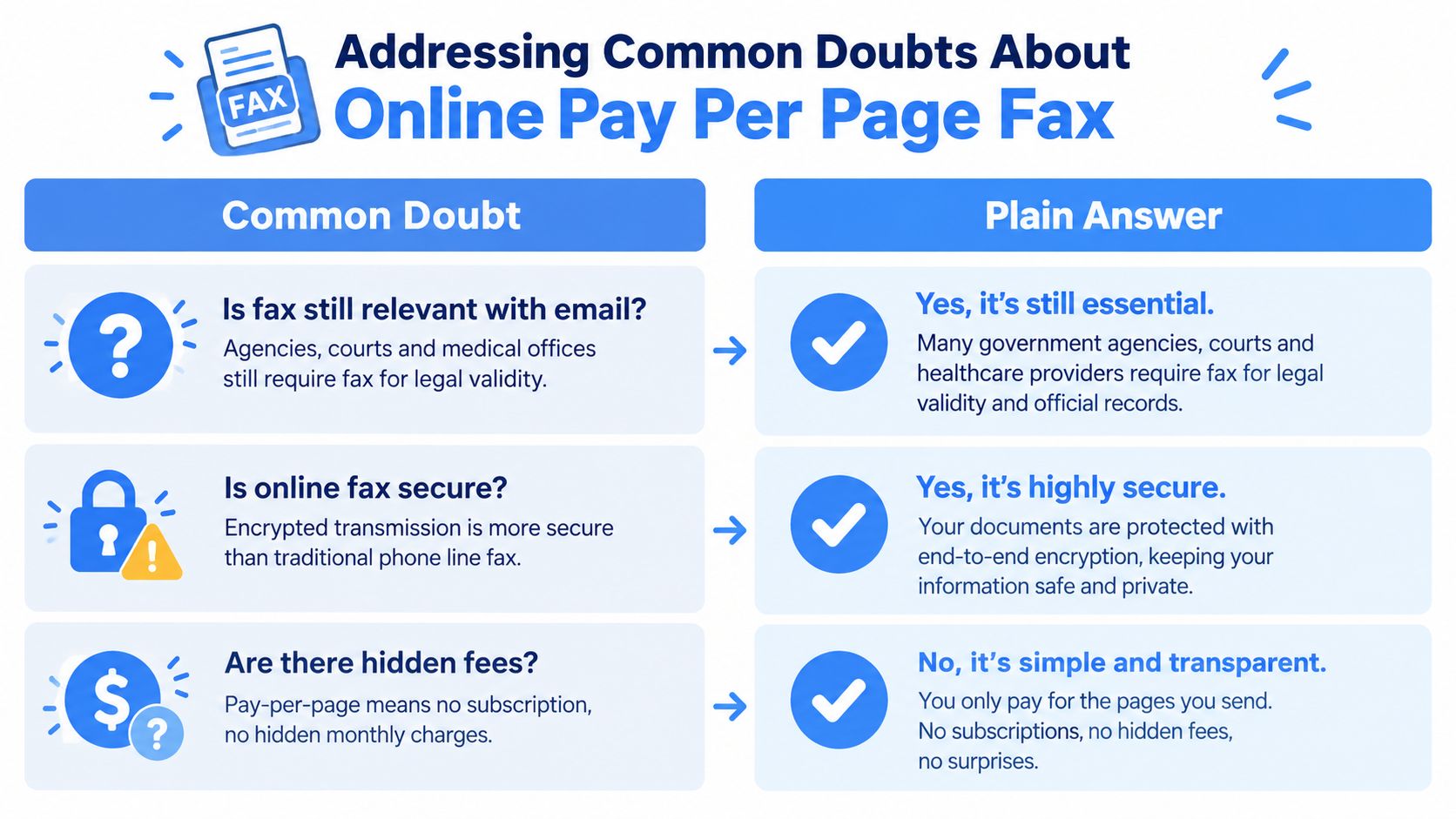
Email feels like the obvious replacement for fax, but the recipient controls the acceptable channel. Healthcare offices, courts, government agencies, and other institutions may still direct people to fax documents because their internal intake process is built around that method. Independent coverage says 70% to 90% of U.S. healthcare communications still touch fax in some form, according to coverage of fax's continued role in digital workflows.
“Is a subscription always cheaper?”
Only if you use enough of what the subscription includes. A recurring plan can be efficient for regular senders, but an occasional sender may pay during inactive months, lose unused pages, or face overage charges when a sudden large filing arrives.
A per-page service reverses that risk. The user pays for the transmission at hand and doesn't need to estimate annual usage. That may produce a higher cost per individual page than a heavily used bulk plan, but the total cost can still be more appropriate when sending is infrequent.
“Does sent mean delivered?”
Not necessarily. “Submitted” may mean the service accepted the file, while “queued” may mean the transmission is waiting for a route or retry. Delivery should be treated as complete only when the recipient device acknowledges receipt and the service provides a final outcome.
Delivery evidence: Keep a report that identifies the destination, time, page count, and completed status. A payment receipt alone doesn't prove that the fax arrived.
“Is online fax reliable under pressure?”
Reliability depends on the service architecture, destination, and status process. Store-and-forward cloud systems can retry busy or failed routes, but the sender still needs to monitor the final result instead of closing the browser after upload.
The deadline question matters, too. Some government procedures permit fax filing only under specific conditions and page limits. Guidance from the Federal Labor Relations Authority illustrates that fax filings may remain available within defined rules, making timing and proof more important than choosing the lowest advertised page price (FLRA fax filing guidance).
An occasional sender is usually buying certainty for one transmission. A clear final status, retry policy, and saveable receipt can matter more than a small monthly saving that comes with a recurring obligation.
Deciding If a Pay As You Go Fax Service Fits You
Use a quick self-check based on behavior, not on the number of features listed on a pricing page.
Start with sending frequency
If you send only occasionally, pay-per-page billing is naturally aligned with your use. If your team sends faxes every week or every day, compare the expected page volume with the subscription's allowance, overage rules, receiving features, and renewal terms.
Check the document risk
Ask whether the fax supports a tax filing, legal notice, medical request, government submission, or another document where delivery proof matters. If the answer is yes, prioritize recipient acknowledgment, a timestamp, page count, final outcome, and a report you can save.
Consider destination complexity
Domestic sending may be straightforward, but international faxing requires country selection and correct dialing format. Confirm that the destination is supported before preparing the final file, especially when the recipient is an institution with a strict number format.
Look at unused monthly spending
Review the months when you didn't send a fax. If you were still paying for an active subscription, per-page billing may better match your actual behavior. If you need a permanent fax number or incoming delivery, the subscription may justify itself even when outbound volume is moderate.
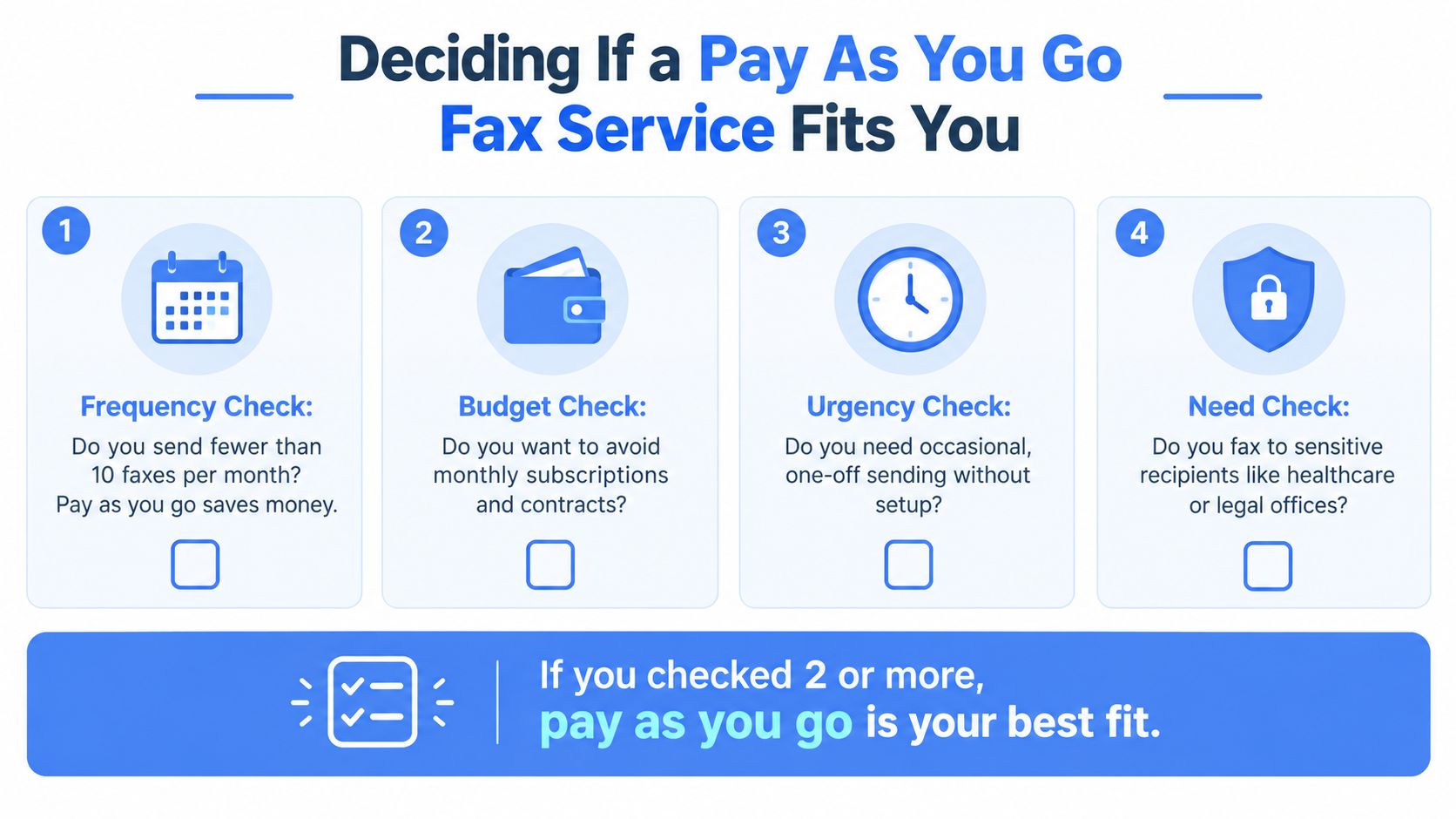
A useful signal: If you send fewer than five faxes a month or need proof for legal and tax filings, investigate pay-per-page options first.
Before sending, check the destination country, prepare a readable PDF when possible, verify the document's page count, and budget by transmission rather than by month. Confirm whether the cover page counts, understand the retry policy, and decide where you'll store the final receipt.
For occasional users, the strongest fit is usually clear: no hardware, no standing plan, a visible charge, and evidence that the recipient device acknowledged the fax. PerPageFax offers outbound browser-based faxing with $0.50 USD per page, no account or subscription, international destination selection, live status tracking, and automatic retries, according to the publisher information provided for this guide.
If you need to send one document without opening a recurring account, visit PerPageFax to upload your file, select the destination, review the page-based charge, and track the transmission. Prepare your document and recipient number now so you can send quickly when a tax, legal, business, or international deadline arrives.
Ready to send a fax?
Send your fax online in minutes for $0.50/page — no account needed.
Send a fax now